Textbook Question
Find the exact value of each real number y if it exists. Do not use a calculator.
y = sin⁻¹ (―1)
722
views

 Lial 12th EditionCh. 6 - Inverse Circular Functions and Trigonometric EquationsProblem 15
 Verified step by step guidance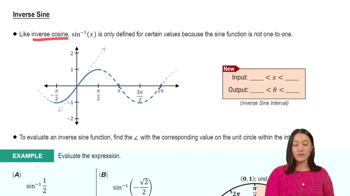
 4:03
4:03
 4:22
4:22 5:28
5:28Find the exact value of each real number y if it exists. Do not use a calculator.
y = sin⁻¹ (―1)
Find the exact value of each real number y. Do not use a calculator.
y = arccot (―1)
Give the degree measure of θ. Do not use a calculator.
θ = arcsin (―√3/2)
Solve each equation for exact solutions over the interval [0, 2π).
2 cot x + 1 = ―1
Solve each equation for x, where x is restricted to the given interval.
y = ― 2 cos 5x , for x in [0, π/5]
Find the exact value of each real number y if it exists. Do not use a calculator.
y = cos⁻¹ (―1)