Graph each function over a two-period interval. y = -2 + (1/2) sin 3x
Verified step by step guidance
1
Identify the given function: \(y = -2 + \frac{1}{2} \sin(3x)\).
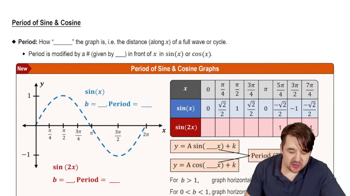
Determine the period of the sine function. Recall that the period of \(\sin(bx)\) is \(\frac{2\pi}{b}\). Here, \(b = 3\), so the period is \(\frac{2\pi}{3}\).
Since the problem asks to graph over a two-period interval, calculate the interval length as \(2 \times \frac{2\pi}{3} = \frac{4\pi}{3}\).
Set up the x-axis interval for the graph, for example from \(x = 0\) to \(x = \frac{4\pi}{3}\), or any other interval of length \(\frac{4\pi}{3}\).
Plot key points by evaluating \(y\) at important values of \(x\) within the interval, such as at multiples of \(\frac{\pi}{6}\) or \(\frac{\pi}{3}\), considering the amplitude \(\frac{1}{2}\) and vertical shift \(-2\).
Verified video answer for a similar problem:
This video solution was recommended by our tutors as helpful for the problem above
Play a video:
0 Comments
Key Concepts
Here are the essential concepts you must grasp in order to answer the question correctly.
Sine Function and Its Properties
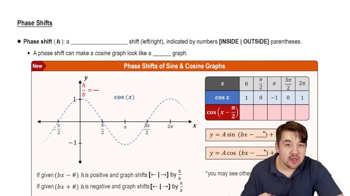
The sine function, sin(x), is a periodic trigonometric function with a fundamental period of 2π. It oscillates between -1 and 1, producing a smooth wave. Understanding its shape and behavior is essential for graphing transformations and shifts.
Amplitude determines the height of the wave from its midline, frequency affects how many cycles occur in a given interval, and vertical shift moves the graph up or down. In y = -2 + (1/2) sin 3x, amplitude is 1/2, frequency is 3 (affecting period), and vertical shift is -2.
The period is the length of one complete cycle of the function. For y = sin(bx), the period is 2π divided by |b|. Here, with b = 3, the period is 2π/3, so a two-period interval spans 4π/3, which guides the domain over which to graph the function.

 Verified step by step guidance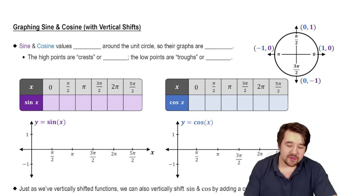
 5:53
5:53