Rationalize each denominator. See Example 8. 6—— √5
Verified step by step guidance
1
Identify the expression that needs rationalization: \( \frac{6}{\sqrt{5}} \).
To rationalize the denominator, multiply both the numerator and the denominator by \( \sqrt{5} \).
This gives: \( \frac{6 \times \sqrt{5}}{\sqrt{5} \times \sqrt{5}} \).
Simplify the denominator: \( \sqrt{5} \times \sqrt{5} = 5 \).
The expression becomes: \( \frac{6\sqrt{5}}{5} \).
Verified video answer for a similar problem:
This video solution was recommended by our tutors as helpful for the problem above
Video duration:
2m
Play a video:
Was this helpful?
Key Concepts
Here are the essential concepts you must grasp in order to answer the question correctly.
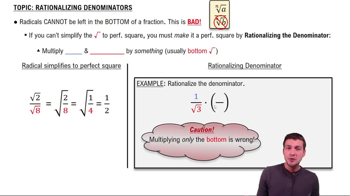
Rationalizing the Denominator
Rationalizing the denominator involves eliminating any irrational numbers from the denominator of a fraction. This is typically done by multiplying both the numerator and the denominator by a suitable expression that will result in a rational number in the denominator. For example, to rationalize a fraction with a square root in the denominator, you multiply by the same square root.
A square root of a number is a value that, when multiplied by itself, gives the original number. In the context of rationalizing denominators, square roots often appear in fractions, and understanding how to manipulate them is crucial. For instance, the square root of 5 (√5) is an irrational number, and rationalizing it helps to simplify expressions for easier computation.
When dealing with expressions that involve square roots, multiplying by the conjugate can be a useful technique. The conjugate of a binomial expression is formed by changing the sign between two terms. In the case of a single square root in the denominator, simply multiplying by that square root will suffice. This method ensures that the resulting denominator is a rational number.