Rationalize each denominator. See Example 8. 18—— √27
Verified step by step guidance
1
Identify the denominator that needs to be rationalized: \( \sqrt{27} \).
Express \( \sqrt{27} \) in terms of its prime factors: \( \sqrt{27} = \sqrt{3^3} = 3\sqrt{3} \).
Multiply the numerator and the denominator by \( \sqrt{3} \) to rationalize the denominator: \( \frac{18}{3\sqrt{3}} \times \frac{\sqrt{3}}{\sqrt{3}} \).
Simplify the expression: \( \frac{18\sqrt{3}}{3 \times 3} \).
Further simplify the fraction by dividing the numerator and the denominator by their greatest common divisor.
Verified video answer for a similar problem:
This video solution was recommended by our tutors as helpful for the problem above
Video duration:
4m
Play a video:
Was this helpful?
Key Concepts
Here are the essential concepts you must grasp in order to answer the question correctly.
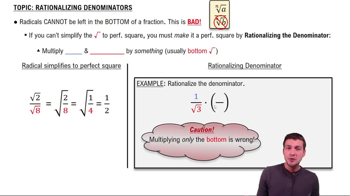
Rationalizing the Denominator
Rationalizing the denominator involves eliminating any irrational numbers from the denominator of a fraction. This is typically achieved by multiplying both the numerator and the denominator by a suitable expression that will result in a rational number in the denominator. For example, if the denominator is a square root, multiplying by the same square root can help achieve this.
Understanding the properties of square roots is essential for rationalizing denominators. The square root of a product can be expressed as the product of the square roots, and the square root of a quotient can be expressed as the quotient of the square roots. This knowledge allows for simplification and manipulation of expressions involving square roots.
Simplifying radicals involves reducing a square root to its simplest form, which often includes factoring out perfect squares. For instance, √27 can be simplified to 3√3, as 27 is 9 times 3, and 9 is a perfect square. This simplification is crucial when rationalizing denominators, as it leads to a clearer and more manageable expression.