Rationalize each denominator. See Example 8. 5—— √5
Verified step by step guidance
1
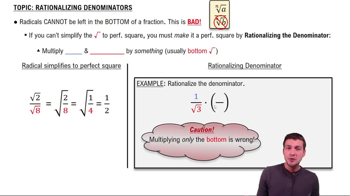
Identify the need to rationalize the denominator, which involves eliminating the square root from the denominator.
Multiply both the numerator and the denominator by the conjugate of the denominator. In this case, multiply by \( \sqrt{5} \).
Write the expression as \( \frac{5}{\sqrt{5}} \times \frac{\sqrt{5}}{\sqrt{5}} \).
Simplify the numerator: \( 5 \times \sqrt{5} = 5\sqrt{5} \).
Simplify the denominator: \( \sqrt{5} \times \sqrt{5} = 5 \).
Verified video answer for a similar problem:
This video solution was recommended by our tutors as helpful for the problem above
Video duration:
1m
Play a video:
Was this helpful?
Key Concepts
Here are the essential concepts you must grasp in order to answer the question correctly.
Rationalizing the Denominator
Rationalizing the denominator involves eliminating any irrational numbers from the denominator of a fraction. This is typically achieved by multiplying both the numerator and the denominator by a suitable expression that will result in a rational number in the denominator. For example, to rationalize a denominator like √5, you would multiply by √5/√5.
Understanding the properties of square roots is essential for rationalizing denominators. The key property is that the square root of a product is the product of the square roots, i.e., √(a*b) = √a * √b. This property allows us to manipulate expressions involving square roots effectively, facilitating the rationalization process.
Simplifying fractions is the process of reducing a fraction to its simplest form, where the numerator and denominator have no common factors other than 1. This is important after rationalizing the denominator, as it ensures the final expression is as concise as possible. For instance, after rationalizing, you may need to simplify the resulting fraction to present the answer clearly.