
Write each expression in terms of sine and cosine, and then simplify the expression so that no quotients appear and all functions are of θ only. See Example 3. (sin θ - cos θ) (csc θ + sec θ)
Verified step by step guidance
1
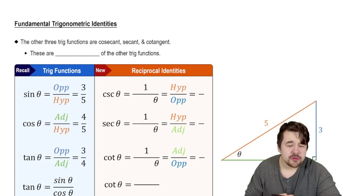
Rewrite \( \csc \theta \) as \( \frac{1}{\sin \theta} \) and \( \sec \theta \) as \( \frac{1}{\cos \theta} \).
Substitute these into the expression: \((\sin \theta - \cos \theta) \left( \frac{1}{\sin \theta} + \frac{1}{\cos \theta} \right)\).
This video solution was recommended by our tutors as helpful for the problem above
Play a video:
Was this helpful?
Key Concepts
Here are the essential concepts you must grasp in order to answer the question correctly.
Trigonometric Identities
Trigonometric identities are equations that involve trigonometric functions and are true for all values of the variable where both sides of the equation are defined. Key identities include the Pythagorean identities, reciprocal identities, and quotient identities. Understanding these identities is essential for rewriting trigonometric expressions in terms of sine and cosine.
Reciprocal functions in trigonometry refer to the relationships between sine, cosine, and their respective reciprocals: cosecant (csc), secant (sec), and cotangent (cot). For example, csc θ = 1/sin θ and sec θ = 1/cos θ. Recognizing these relationships allows for the conversion of expressions involving csc and sec into sine and cosine, facilitating simplification.
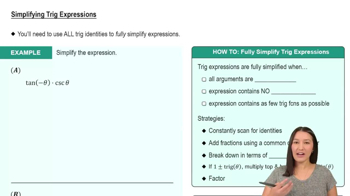
Simplification of trigonometric expressions involves rewriting them in a more manageable form, often eliminating quotients and combining like terms. This process typically uses identities and algebraic manipulation. The goal is to express the original expression solely in terms of sine and cosine, which can make further calculations or evaluations easier.