Write each expression in terms of sine and cosine, and then simplify the expression so that no quotients appear and all functions are of θ only. See Example 3. csc θ - sin θ
Verified step by step guidance
1
Start by expressing \( \csc \theta \) in terms of sine: \( \csc \theta = \frac{1}{\sin \theta} \).
Rewrite the expression \( \csc \theta - \sin \theta \) as \( \frac{1}{\sin \theta} - \sin \theta \).
Find a common denominator for the terms: the common denominator is \( \sin \theta \).
Rewrite \( \sin \theta \) as \( \frac{\sin^2 \theta}{\sin \theta} \) to have the same denominator.
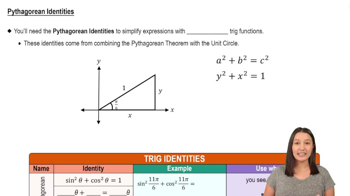
Combine the fractions: \( \frac{1 - \sin^2 \theta}{\sin \theta} \).
Verified video answer for a similar problem:
This video solution was recommended by our tutors as helpful for the problem above
Play a video:
Was this helpful?
Key Concepts
Here are the essential concepts you must grasp in order to answer the question correctly.
Cosecant Function
The cosecant function, denoted as csc(θ), is the reciprocal of the sine function. It is defined as csc(θ) = 1/sin(θ). Understanding this relationship is crucial for rewriting expressions involving csc(θ) in terms of sine and cosine, as it allows us to express all trigonometric functions in a consistent manner.
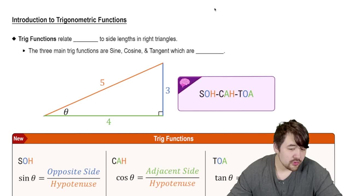
The sine function, sin(θ), is a fundamental trigonometric function that relates the angle θ to the ratio of the length of the opposite side to the hypotenuse in a right triangle. It is essential to recognize how sine interacts with other trigonometric functions, particularly when simplifying expressions that involve csc(θ) and sin(θ).
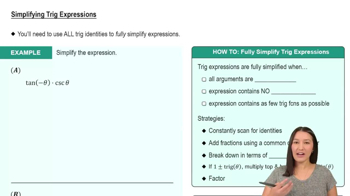
Simplifying trigonometric expressions involves rewriting them in a form that eliminates quotients and expresses all functions in terms of sine and cosine. This process often requires the use of identities and algebraic manipulation, making it easier to analyze and solve trigonometric equations. Mastery of this skill is vital for effectively handling various trigonometric problems.