In Exercises 29–51, find the exact value of each expression. Do not use a calculator.sin⁻¹(sin π/3)
Verified step by step guidance
1
insert step 1> Understand that \( \sin^{-1} \) is the inverse sine function, also known as arcsin, which returns the angle whose sine is the given value.
insert step 2> Recognize that \( \sin^{-1}(\sin(\theta)) = \theta \) if \( \theta \) is within the range of \( \sin^{-1} \), which is \([-\frac{\pi}{2}, \frac{\pi}{2}]\).
insert step 3> Note that \( \frac{\pi}{3} \) is not within the range of \( \sin^{-1} \), as it is greater than \( \frac{\pi}{2} \).
insert step 4> Find an equivalent angle within the range \([-\frac{\pi}{2}, \frac{\pi}{2}]\) that has the same sine value as \( \frac{\pi}{3} \).
insert step 5> Conclude that the equivalent angle is \( \frac{\pi}{3} - \pi = -\frac{2\pi}{3} \), which is not correct, so find the correct angle \( \frac{\pi}{3} - \pi = -\frac{\pi}{3} \) which is within the range.
Verified video answer for a similar problem:
This video solution was recommended by our tutors as helpful for the problem above
Video duration:
1m
Play a video:
Was this helpful?
Key Concepts
Here are the essential concepts you must grasp in order to answer the question correctly.
Inverse Trigonometric Functions
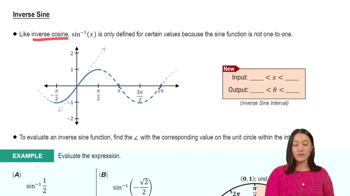
Inverse trigonometric functions, such as sin⁻¹(x), are used to find the angle whose sine is x. These functions return values within a specific range, which for sin⁻¹(x) is typically [-π/2, π/2]. Understanding this range is crucial for determining the correct angle when evaluating expressions involving inverse sine.
The unit circle is a fundamental concept in trigonometry that defines the sine and cosine of angles based on their coordinates on a circle with a radius of one. For example, the angle π/3 corresponds to the coordinates (1/2, √3/2), where the sine value is √3/2. Familiarity with the unit circle helps in visualizing and calculating trigonometric values.
The principal value of an inverse trigonometric function is the unique angle that the function returns, constrained to its defined range. For sin⁻¹(sin θ), if θ is outside the range of [-π/2, π/2], the function will return an equivalent angle within this range. This concept is essential for accurately finding the exact value of expressions involving inverse trigonometric functions.