In Exercises 29–51, find the exact value of each expression. Do not use a calculator.sin⁻¹(cos 2π/3)
Verified step by step guidance
1
insert step 1: Understand the problem involves finding the exact value of the expression \( \sin^{-1}(\cos \frac{2\pi}{3}) \).
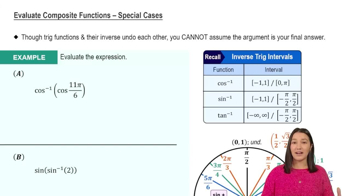
insert step 2: Calculate \( \cos \frac{2\pi}{3} \). Since \( \frac{2\pi}{3} \) is in the second quadrant, where cosine is negative, use the reference angle \( \frac{\pi}{3} \) to find \( \cos \frac{2\pi}{3} = -\cos \frac{\pi}{3} = -\frac{1}{2} \).
insert step 3: Now, substitute \( \cos \frac{2\pi}{3} = -\frac{1}{2} \) into the expression, so it becomes \( \sin^{-1}(-\frac{1}{2}) \).
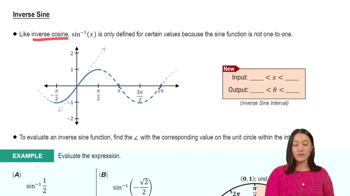
insert step 4: Determine the angle whose sine is \(-\frac{1}{2}\). The angle should be in the range \([-\frac{\pi}{2}, \frac{\pi}{2}]\), which is the range of the inverse sine function.
insert step 5: Recognize that \( \sin(-\frac{\pi}{6}) = -\frac{1}{2} \), so \( \sin^{-1}(-\frac{1}{2}) = -\frac{\pi}{6} \).
Verified video answer for a similar problem:
This video solution was recommended by our tutors as helpful for the problem above
Video duration:
2m
Play a video:
Was this helpful?
Key Concepts
Here are the essential concepts you must grasp in order to answer the question correctly.
Inverse Trigonometric Functions
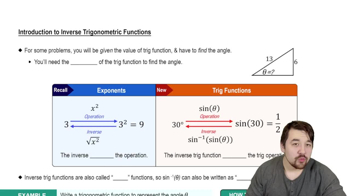
Inverse trigonometric functions, such as sin⁻¹(x), are used to find the angle whose sine is x. These functions are essential for solving equations where the angle is unknown. The range of the inverse sine function is restricted to [-π/2, π/2] to ensure it is a function, meaning it can only return one value for each input.
The unit circle is a circle with a radius of one centered at the origin of a coordinate plane. It is fundamental in trigonometry as it provides a geometric interpretation of sine, cosine, and tangent values. The coordinates of points on the unit circle correspond to the cosine and sine of angles, allowing for easy calculation of trigonometric values.
The cosine function relates to the x-coordinate of a point on the unit circle. For angles in different quadrants, the cosine value can be positive or negative. Reference angles help determine the sine and cosine values for angles greater than 90 degrees by relating them back to their acute counterparts, which is crucial for evaluating expressions like cos(2π/3).