Graph each function over a two-period interval. y= -1 + (1/2) cot (2x - 3π)
Verified step by step guidance
1
Identify the given function: \(y = -1 + \frac{1}{2} \cot(2x - 3\pi)\).
Recall that the cotangent function \(\cot(\theta)\) has a period of \(\pi\). Since the argument of the cotangent is \(2x - 3\pi\), the period of the function changes according to the coefficient of \(x\). The period \(T\) is given by \(T = \frac{\pi}{|2|} = \frac{\pi}{2}\).
Since the problem asks to graph over a two-period interval, determine the interval length: \(2 \times T = 2 \times \frac{\pi}{2} = \pi\). Choose an interval of length \(\pi\) for \(x\), for example from \(x = a\) to \(x = a + \pi\), where \(a\) can be chosen to include the phase shift.
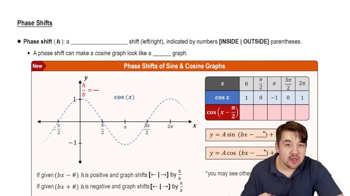
Analyze the phase shift caused by \(-3\pi\) inside the cotangent argument. Set the inside of the cotangent equal to zero to find the horizontal shift: \(2x - 3\pi = 0 \Rightarrow x = \frac{3\pi}{2}\). This means the cotangent function is shifted to the right by \(\frac{3\pi}{2}\).
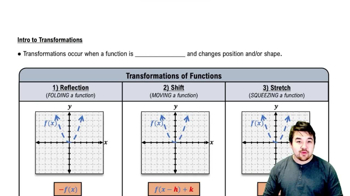
Plot key points of the cotangent function within the chosen interval, considering the amplitude scaling by \(\frac{1}{2}\) and the vertical shift down by 1. Remember that \(\cot(\theta)\) has vertical asymptotes where \(\sin(\theta) = 0\), i.e., at multiples of \(\pi\). Use these to sketch the graph accurately.
Verified video answer for a similar problem:
This video solution was recommended by our tutors as helpful for the problem above
Play a video:
0 Comments
Key Concepts
Here are the essential concepts you must grasp in order to answer the question correctly.
Period of Trigonometric Functions
The period of a trigonometric function is the length of the interval over which the function completes one full cycle. For cotangent, the basic period is π, but when the function argument is multiplied by a factor (like 2 in cot(2x - 3π)), the period changes to π divided by that factor, affecting the graph's horizontal length.
Phase shift refers to the horizontal translation of a trigonometric graph caused by adding or subtracting a constant inside the function's argument. In cot(2x - 3π), the term -3π shifts the graph horizontally, changing where the function's key points and asymptotes occur along the x-axis.
Vertical transformations include shifts and stretches/compressions applied to the function's output. In y = -1 + (1/2) cot(2x - 3π), the -1 shifts the graph down by one unit, and the factor 1/2 compresses the cotangent's amplitude vertically, altering the height and position of the graph's features.

 Verified step by step guidance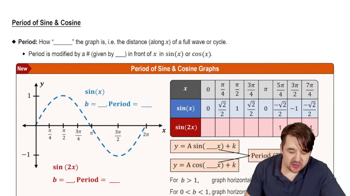
 5:33
5:33