In Exercises 61–66, use the method of adding y-coordinates to graph each function for 0 ≤ x ≤ 2π. y = 3 cos x + sin x
Table of contents
- 0. Review of College Algebra4h 45m
- 1. Measuring Angles40m
- 2. Trigonometric Functions on Right Triangles2h 5m
- 3. Unit Circle1h 19m
- 4. Graphing Trigonometric Functions1h 19m
- 5. Inverse Trigonometric Functions and Basic Trigonometric Equations1h 41m
- 6. Trigonometric Identities and More Equations2h 34m
- 7. Non-Right Triangles1h 38m
- 8. Vectors2h 25m
- 9. Polar Equations2h 5m
- 10. Parametric Equations1h 6m
- 11. Graphing Complex Numbers1h 7m
4. Graphing Trigonometric Functions
Graphs of the Sine and Cosine Functions
Problem 80
Textbook Question
In Exercises 79–82, graph f, g, and h in the same rectangular coordinate system for 0 ≤ x ≤ 2π. Obtain the graph of h by adding or subtracting the corresponding y-coordinates on the graphs of f and g. f(x) = 2 cos x, g(x) = cos 2x, h(x) = (f + g)(x)
Verified step by step guidance1
Identify the given functions: \(f(x) = 2 \cos x\), \(g(x) = \cos 2x\), and \(h(x) = (f + g)(x) = f(x) + g(x)\).
Understand that to graph \(h(x)\), you need to add the corresponding \(y\)-values of \(f(x)\) and \(g(x)\) for each \(x\) in the interval \(0 \leq x \leq 2\pi\).
Create a table of values for \(x\) at key points within \$0\( to \(2\pi\) (such as \)0\(, \(\frac{\pi}{2}\), \(\pi\), \(\frac{3\pi}{2}\), and \(2\pi\)). Calculate \)f(x)\( and \)g(x)$ at each of these points.
Add the values from \(f(x)\) and \(g(x)\) at each \(x\) to find \(h(x)\), i.e., compute \(h(x) = 2 \cos x + \cos 2x\) for each \(x\).
Plot the points for \(f(x)\), \(g(x)\), and \(h(x)\) on the same coordinate system and draw smooth curves through these points to visualize how \(h(x)\) is formed by adding the graphs of \(f\) and \(g\).
Verified video answer for a similar problem:This video solution was recommended by our tutors as helpful for the problem above
Video duration:
6mPlay a video:
0 Comments
Key Concepts
Here are the essential concepts you must grasp in order to answer the question correctly.
Graphing Trigonometric Functions
Graphing trigonometric functions involves plotting their values over a specified domain, such as 0 to 2π. Understanding the shape, period, amplitude, and phase shift of functions like cosine helps visualize their behavior and compare multiple functions on the same coordinate system.
Recommended video:
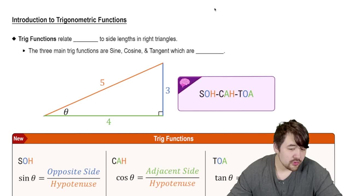
Introduction to Trigonometric Functions
Function Addition and Pointwise Operations
Adding functions means combining their outputs for each input value. For h(x) = f(x) + g(x), the y-coordinate of h at any x is the sum of the y-coordinates of f and g at that x. This concept is essential for constructing the graph of h from f and g.
Recommended video:
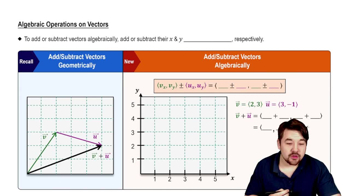
Algebraic Operations on Vectors
Properties of Cosine Functions and Frequency
Cosine functions like cos x and cos 2x differ in frequency; cos 2x completes two cycles in the interval 0 to 2π, while cos x completes one. Recognizing how frequency affects the graph's oscillations is crucial for accurately plotting and combining these functions.
Recommended video:
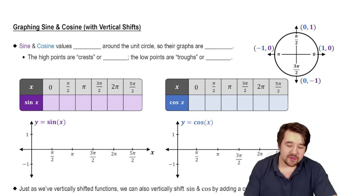
Graph of Sine and Cosine Function
Related Videos
Related Practice
Textbook Question
612
views