In Exercises 61–66, use the method of adding y-coordinates to graph each function for 0 ≤ x ≤ 2π. y = cos x + cos 2x
Table of contents
- 0. Review of College Algebra4h 45m
- 1. Measuring Angles40m
- 2. Trigonometric Functions on Right Triangles2h 5m
- 3. Unit Circle1h 19m
- 4. Graphing Trigonometric Functions1h 19m
- 5. Inverse Trigonometric Functions and Basic Trigonometric Equations1h 41m
- 6. Trigonometric Identities and More Equations2h 34m
- 7. Non-Right Triangles1h 38m
- 8. Vectors2h 25m
- 9. Polar Equations2h 5m
- 10. Parametric Equations1h 6m
- 11. Graphing Complex Numbers1h 7m
4. Graphing Trigonometric Functions
Graphs of the Sine and Cosine Functions
Problem 82
Textbook Question
In Exercises 79–82, graph f, g, and h in the same rectangular coordinate system for 0 ≤ x ≤ 2π. Obtain the graph of h by adding or subtracting the corresponding y-coordinates on the graphs of f and g. f(x) = cos x, g(x) = sin 2x, h(x) = (f − g)(x)
Verified step by step guidance1
Identify the given functions: \(f(x) = \cos x\), \(g(x) = \sin 2x\), and \(h(x) = (f - g)(x) = f(x) - g(x)\).
Understand that to find \(h(x)\), you subtract the value of \(g(x)\) from \(f(x)\) for each \(x\) in the interval \(0 \leq x \leq 2\pi\).
Create a table of values for \(x\) at key points (such as \$0\(, \(\frac{\pi}{2}\), \(\pi\), \(\frac{3\pi}{2}\), and \(2\pi\)), and calculate \)f(x)\(, \)g(x)\(, and then \)h(x) = f(x) - g(x)$ for each point.
Plot the graphs of \(f(x) = \cos x\) and \(g(x) = \sin 2x\) on the same coordinate system over the interval \(0 \leq x \leq 2\pi\).
Using the values of \(h(x)\) from your table, plot the graph of \(h(x)\) by subtracting the \(y\)-coordinates of \(g(x)\) from those of \(f(x)\) at each \(x\), resulting in the graph of \(h\).
Verified video answer for a similar problem:This video solution was recommended by our tutors as helpful for the problem above
Video duration:
6mPlay a video:
0 Comments
Key Concepts
Here are the essential concepts you must grasp in order to answer the question correctly.
Graphing Trigonometric Functions
Graphing trigonometric functions involves plotting their values over a specified interval, such as 0 to 2π. Understanding the shape, period, amplitude, and key points of functions like cosine and sine is essential to accurately represent them on a coordinate system.
Recommended video:
Introduction to Trigonometric Functions
Function Operations (Addition and Subtraction)
Function operations involve combining two functions by adding or subtracting their outputs for each input value. For h(x) = (f − g)(x), this means subtracting the y-values of g(x) from f(x) at every x, resulting in a new function whose graph is derived from the pointwise difference.
Recommended video:
Adding and Subtracting Complex Numbers
Periodicity and Frequency of Trigonometric Functions
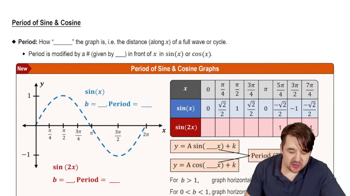
Periodicity refers to the repeating nature of trig functions. Cos x has a period of 2π, while sin 2x has a period of π due to the frequency multiplier 2. Recognizing these periods helps in understanding how the combined function h(x) behaves and repeats over the interval.
Recommended video:
Period of Sine and Cosine Functions
Related Videos
Related Practice
Textbook Question
727
views