A ship leaves port on a bearing of 34.0° and travels 10.4 mi. The ship then turns due east and travels 4.6 mi. How far is the ship from port, and what is its bearing from port?
Verified step by step guidance
1
Step 1: Visualize the problem by drawing a diagram. Start by plotting the initial position of the ship at the origin of a coordinate system.
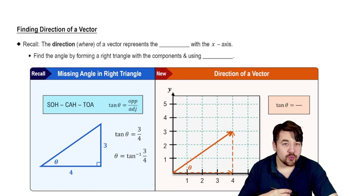
Step 2: Represent the first leg of the journey. The ship travels 10.4 miles on a bearing of 34.0°. Convert this bearing into a standard angle from the positive x-axis (east direction) by subtracting it from 90°, resulting in an angle of 56.0° from the x-axis.
Step 3: Calculate the coordinates of the ship after the first leg using trigonometry. Use the formulas: x = 10.4 * cos(56.0°) and y = 10.4 * sin(56.0°) to find the position of the ship.
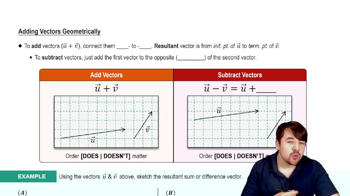
Step 4: Represent the second leg of the journey. The ship turns due east and travels 4.6 miles. Add this distance to the x-coordinate from Step 3, keeping the y-coordinate the same.
Step 5: Determine the distance from the port using the distance formula: distance = sqrt((x_final - x_initial)^2 + (y_final - y_initial)^2). Calculate the bearing from the port by finding the angle whose tangent is the ratio of the y-coordinate to the x-coordinate.
Verified video answer for a similar problem:
This video solution was recommended by our tutors as helpful for the problem above
Video duration:
10m
Play a video:
Was this helpful?
Key Concepts
Here are the essential concepts you must grasp in order to answer the question correctly.
Bearing
Bearing is a way of describing direction using angles measured clockwise from the north. In this context, a bearing of 34.0° indicates that the ship is traveling 34 degrees clockwise from true north. Understanding bearings is crucial for determining the ship's direction and calculating its final position relative to the port.
Trigonometric Functions
Trigonometric functions, such as sine, cosine, and tangent, relate the angles of a triangle to the lengths of its sides. In this problem, these functions can be used to resolve the ship's movements into their respective horizontal and vertical components, which are essential for calculating the ship's final distance from the port.
The Pythagorean Theorem states that in a right triangle, the square of the length of the hypotenuse is equal to the sum of the squares of the lengths of the other two sides. This theorem is vital for finding the straight-line distance from the port to the ship after it has traveled in two segments, allowing for the calculation of the resultant distance using the components derived from the ship's path.