Two people are carrying a box. One person exerts a force of 150 lb at an angle of 62.4° with the horizontal. The other person exerts a force of 114 lb at an angle of 54.9°. Find the weight of the box.
<IMAGE>
Verified step by step guidance
1
Identify the forces exerted by each person: 150 lb at 62.4° and 114 lb at 54.9°.
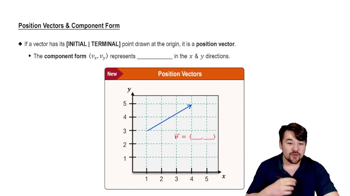
Resolve each force into horizontal and vertical components using trigonometric functions.
For the first force: Calculate the horizontal component using 150 lb * cos(62.4°) and the vertical component using 150 lb * sin(62.4°).
For the second force: Calculate the horizontal component using 114 lb * cos(54.9°) and the vertical component using 114 lb * sin(54.9°).
Sum the vertical components of both forces to find the total vertical force, which equals the weight of the box.
Verified video answer for a similar problem:
This video solution was recommended by our tutors as helpful for the problem above
Play a video:
Was this helpful?
Key Concepts
Here are the essential concepts you must grasp in order to answer the question correctly.
Vector Resolution
Vector resolution involves breaking down a force vector into its horizontal and vertical components. This is essential in physics and trigonometry, as it allows us to analyze forces acting at angles. For a force F at an angle θ, the horizontal component is F*cos(θ) and the vertical component is F*sin(θ). Understanding this concept is crucial for solving problems involving forces at angles.
In physics, an object is in equilibrium when the sum of all forces acting on it is zero. This principle is vital for determining the weight of the box in this scenario. By calculating the vertical components of the forces exerted by both individuals and setting their sum equal to the weight of the box, we can find the box's weight. This concept is foundational in statics and dynamics.
Trigonometric functions, such as sine, cosine, and tangent, relate the angles of a triangle to the ratios of its sides. In this problem, these functions are used to calculate the components of the forces exerted at specific angles. Mastery of these functions is essential for solving problems involving angles and distances in trigonometry and physics.