Evaluate each expression without using a calculator. arccos (cos (3π/4))
Verified step by step guidance
1
Recall that the function \( \arccos(x) \) is the inverse of \( \cos(x) \) but its output (range) is restricted to \( [0, \pi] \). This means \( \arccos(\cos(\theta)) = \theta \) only if \( \theta \) is within \( [0, \pi] \).
Identify the given angle: \( \theta = \frac{3\pi}{4} \). Note that \( \frac{3\pi}{4} \) is within the interval \( [0, \pi] \), so it lies in the principal range of \( \arccos \).
Since \( \theta = \frac{3\pi}{4} \) is already in the principal range, \( \arccos(\cos(\frac{3\pi}{4})) = \frac{3\pi}{4} \).
If the angle were outside the principal range, you would need to find an equivalent angle within \( [0, \pi] \) that has the same cosine value, using the periodicity and symmetry of the cosine function.
Therefore, the evaluation simplifies to recognizing the principal value of the inverse cosine function applied to the cosine of the given angle.
Verified video answer for a similar problem:
This video solution was recommended by our tutors as helpful for the problem above
Play a video:
0 Comments
Key Concepts
Here are the essential concepts you must grasp in order to answer the question correctly.
Inverse Trigonometric Functions
Inverse trigonometric functions, like arccos, reverse the effect of their corresponding trigonometric functions. For arccos, it returns the angle whose cosine is a given value, typically within the principal range of 0 to π radians.
The arccos function is defined to return values only within the principal range [0, π]. This means when evaluating arccos(cos(θ)), the result is the angle in [0, π] that has the same cosine value as θ.
Cosine is a periodic function with period 2π and is symmetric about the y-axis (even function). This means cos(θ) = cos(2π - θ), which helps in simplifying expressions like arccos(cos(3π/4)) by relating angles outside the principal range to those inside it.

 Verified step by step guidance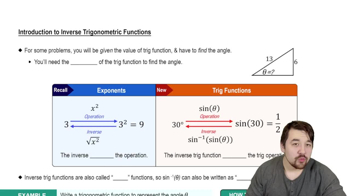
 4:28
4:28