Solve each equation for exact solutions. 6 sin⁻¹ x = 5π
Verified step by step guidance
1
Start by isolating the inverse sine function: divide both sides of the equation by 6 to get \( \sin^{-1}(x) = \frac{5\pi}{6} \).
Recall that \( \sin^{-1}(x) \) represents the angle whose sine is \( x \). Therefore, set \( x = \sin\left(\frac{5\pi}{6}\right) \).
Use the unit circle or trigonometric identities to find \( \sin\left(\frac{5\pi}{6}\right) \).
Recognize that \( \frac{5\pi}{6} \) is in the second quadrant where sine is positive, and it is equivalent to \( \pi - \frac{\pi}{6} \).
Calculate \( \sin\left(\pi - \frac{\pi}{6}\right) \) using the identity \( \sin(\pi - \theta) = \sin(\theta) \).
Verified video answer for a similar problem:
This video solution was recommended by our tutors as helpful for the problem above
Play a video:
Was this helpful?
Key Concepts
Here are the essential concepts you must grasp in order to answer the question correctly.
Inverse Trigonometric Functions
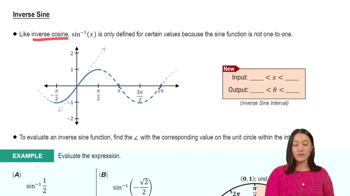
Inverse trigonometric functions, such as sin⁻¹ (arcsin), are used to find the angle whose sine is a given value. In this context, solving the equation involves understanding how to manipulate these functions to isolate the variable x. The output of sin⁻¹ x is an angle, typically expressed in radians, which is crucial for further calculations.
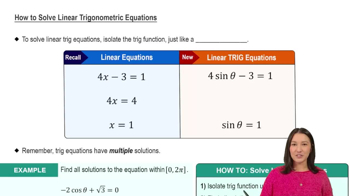
Solving trigonometric equations requires applying algebraic techniques and understanding the periodic nature of trigonometric functions. In this case, the equation involves isolating x and determining the corresponding angles that satisfy the equation. Recognizing the periodicity of the sine function is essential for finding all possible solutions.
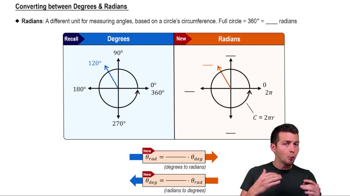
Radian measure is a way of measuring angles based on the radius of a circle. In this problem, the equation includes 5π, which is expressed in radians. Understanding how to convert between degrees and radians, as well as how to interpret angles in the context of the unit circle, is vital for accurately solving the equation and finding exact solutions.