Graph each function over a one-period interval. y = csc((1/2)x - π/4)
Verified step by step guidance
1
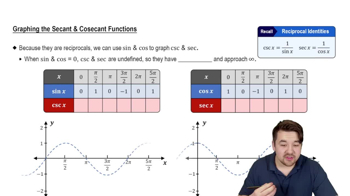
Identify the basic function: The function given is \( y = \csc((1/2)x - \pi/4) \). The cosecant function, \( \csc(x) \), is the reciprocal of the sine function, \( \sin(x) \).
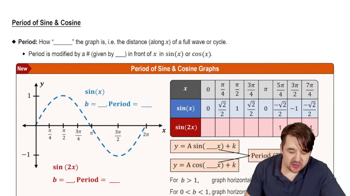
Determine the period of the function: The period of \( \csc(bx) \) is \( \frac{2\pi}{b} \). Here, \( b = \frac{1}{2} \), so the period is \( 4\pi \).
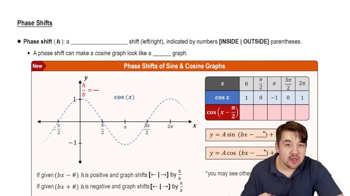
Find the phase shift: The phase shift is determined by the expression \( bx - c \). Here, \( c = \pi/4 \), so the phase shift is \( \frac{\pi/4}{1/2} = \pi/2 \) to the right.
Identify the vertical asymptotes: The vertical asymptotes of \( \csc(x) \) occur where \( \sin(x) = 0 \). For \( \csc((1/2)x - \pi/4) \), solve \( (1/2)x - \pi/4 = n\pi \) for \( x \), where \( n \) is an integer.
Graph the function: Plot the vertical asymptotes and sketch the \( \csc \) curve, which will have branches approaching the asymptotes. The function will repeat every \( 4\pi \) units along the x-axis.
Verified video answer for a similar problem:
This video solution was recommended by our tutors as helpful for the problem above
Play a video:
0 Comments
Key Concepts
Here are the essential concepts you must grasp in order to answer the question correctly.
Cosecant Function
The cosecant function, denoted as csc(x), is the reciprocal of the sine function. It is defined as csc(x) = 1/sin(x). The cosecant function is undefined wherever the sine function is zero, leading to vertical asymptotes in its graph. Understanding the properties of the sine function is crucial for accurately graphing the cosecant function.
The period of a trigonometric function is the length of one complete cycle of the function. For the cosecant function, the standard period is 2π. However, when the function is transformed, such as by a coefficient in front of x, the period can change. In the given function, the coefficient (1/2) indicates that the period will be stretched to 4π.
Phase shift refers to the horizontal shift of a trigonometric function along the x-axis. It is determined by the constant added or subtracted from the variable inside the function. In the function y = csc((1/2)x - π/4), the phase shift can be calculated by setting the inside of the function equal to zero, resulting in a shift of π/2 to the right. This shift affects the starting point of the graph.