Write each function value in terms of the cofunction of a complementary angle. tan 174° 03'
Verified step by step guidance
1
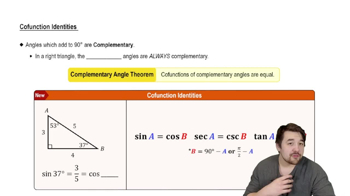
Recall the cofunction identity for tangent: \(\tan(\theta) = \cot(90^\circ - \theta)\), where the angles are complementary (sum to \(90^\circ\)).
Identify the given angle: \(174^\circ 03'\) (which is \$174\( degrees and \)3$ minutes).
Calculate the complementary angle to \(174^\circ 03'\) with respect to \(90^\circ\): compute \(90^\circ - 174^\circ 03'\).
Since \(174^\circ 03'\) is greater than \(90^\circ\), note that the direct complementary angle with respect to \(90^\circ\) will be negative, so consider the identity carefully or use the periodicity of tangent and cotangent functions.
Express \(\tan 174^\circ 03'\) in terms of the cotangent of the complementary angle using the identity: \(\tan 174^\circ 03' = \cot(90^\circ - 174^\circ 03')\).
Verified video answer for a similar problem:
This video solution was recommended by our tutors as helpful for the problem above
Play a video:
0 Comments
Key Concepts
Here are the essential concepts you must grasp in order to answer the question correctly.
Complementary Angles
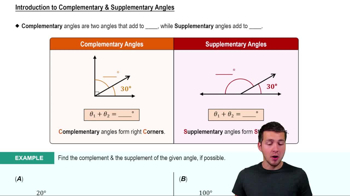
Complementary angles are two angles whose measures add up to 90 degrees. In trigonometry, the cofunction identities relate the trigonometric function of an angle to the function of its complementary angle, enabling simplification or transformation of expressions.
Cofunction identities state that the value of a trigonometric function of an angle equals the cofunction of its complement. For example, tan(θ) = cot(90° - θ). These identities help express functions in terms of complementary angles, which is essential for the given problem.
Angles given in degrees and minutes (e.g., 174° 03') must be understood and sometimes converted for calculations. Recognizing how to handle such notation is important for accurately finding complementary angles and applying cofunction identities.