In Exercises 27–38, use a calculator to find the value of each expression rounded to two decimal places.sin⁻¹ 0.3
Verified step by step guidance
1
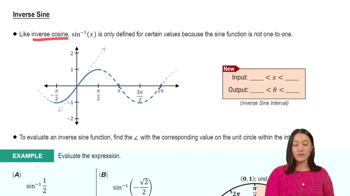
Understand that \( \sin^{-1} \) is the inverse sine function, also known as arcsin, which gives the angle whose sine is the given number.
Set up the equation \( \theta = \sin^{-1}(0.3) \), where \( \theta \) is the angle we need to find.
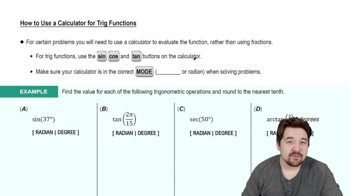
Use a calculator to find \( \theta \) by inputting \( \sin^{-1}(0.3) \).
Ensure the calculator is set to the correct mode (degrees or radians) based on the context of the problem.
Round the result to two decimal places as required.
Verified video answer for a similar problem:
This video solution was recommended by our tutors as helpful for the problem above
Video duration:
1m
Play a video:
Was this helpful?
Key Concepts
Here are the essential concepts you must grasp in order to answer the question correctly.
Inverse Trigonometric Functions
Inverse trigonometric functions, such as sin⁻¹ (arcsin), are used to find the angle whose sine is a given value. For example, sin⁻¹(0.3) asks for the angle θ such that sin(θ) = 0.3. These functions are essential for solving problems where the angle is unknown but the ratio of sides is known.
Using a calculator to evaluate inverse trigonometric functions requires understanding how to access these functions. Most scientific calculators have a dedicated button for inverse functions, often labeled as 'sin⁻¹', 'cos⁻¹', or 'tan⁻¹'. Knowing how to input values correctly and interpret the output is crucial for accurate calculations.
Rounding numbers is a mathematical process used to reduce the number of digits in a number while maintaining its value as close as possible. In this context, rounding the result of sin⁻¹(0.3) to two decimal places means adjusting the output to the nearest hundredth, which is important for presenting answers in a clear and standardized format.