In Exercises 1–8, use the given vectors to find v⋅w and v⋅v.v = 3i + j, w = i + 3j
Verified step by step guidance
1
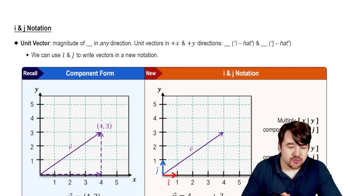
Identify the components of the vectors \( \mathbf{v} \) and \( \mathbf{w} \). Here, \( \mathbf{v} = 3\mathbf{i} + \mathbf{j} \) and \( \mathbf{w} = \mathbf{i} + 3\mathbf{j} \).
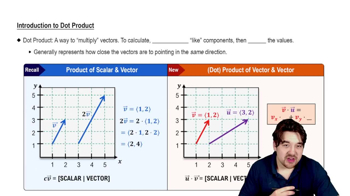
Recall the formula for the dot product of two vectors \( \mathbf{a} = a_1\mathbf{i} + a_2\mathbf{j} \) and \( \mathbf{b} = b_1\mathbf{i} + b_2\mathbf{j} \), which is \( \mathbf{a} \cdot \mathbf{b} = a_1b_1 + a_2b_2 \).
Apply the dot product formula to find \( \mathbf{v} \cdot \mathbf{w} \): \( (3)(1) + (1)(3) \).
Apply the dot product formula to find \( \mathbf{v} \cdot \mathbf{v} \): \( (3)(3) + (1)(1) \).
Simplify the expressions from the previous steps to find the values of \( \mathbf{v} \cdot \mathbf{w} \) and \( \mathbf{v} \cdot \mathbf{v} \).
Verified video answer for a similar problem:
This video solution was recommended by our tutors as helpful for the problem above
Video duration:
2m
Play a video:
Was this helpful?
Key Concepts
Here are the essential concepts you must grasp in order to answer the question correctly.
Dot Product
The dot product is a mathematical operation that takes two vectors and returns a scalar. It is calculated by multiplying corresponding components of the vectors and summing the results. For vectors v = ai + bj and w = ci + dj, the dot product is given by v⋅w = ac + bd. This operation is essential for determining the angle between vectors and their relative orientation.
Vectors can be expressed in terms of their components along the coordinate axes. In the case of v = 3i + j, the components are 3 (along the x-axis) and 1 (along the y-axis). Understanding vector components is crucial for performing operations like the dot product, as it allows for the systematic multiplication and addition of the respective components of the vectors involved.
The magnitude of a vector is a measure of its length and is calculated using the formula |v| = √(a² + b²) for a vector v = ai + bj. This concept is important when calculating the dot product of a vector with itself, as it provides insight into the vector's size and can be used to find the angle between vectors when combined with the dot product.