In Exercises 5–8, letv = -5i + 2j and w = 2i - 4jFind the specified vector, scalar, or angle.v ⋅ w
Verified step by step guidance
1
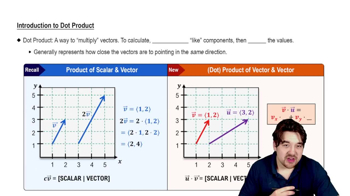
Step 1: Understand the dot product formula. The dot product of two vectors \( \mathbf{v} = a\mathbf{i} + b\mathbf{j} \) and \( \mathbf{w} = c\mathbf{i} + d\mathbf{j} \) is given by \( \mathbf{v} \cdot \mathbf{w} = ac + bd \).
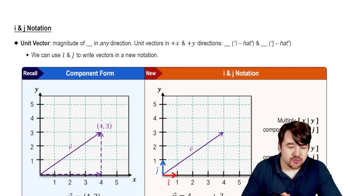
Step 2: Identify the components of the vectors \( \mathbf{v} \) and \( \mathbf{w} \). For \( \mathbf{v} = -5\mathbf{i} + 2\mathbf{j} \), the components are \( a = -5 \) and \( b = 2 \). For \( \mathbf{w} = 2\mathbf{i} - 4\mathbf{j} \), the components are \( c = 2 \) and \( d = -4 \).
Step 3: Substitute the components into the dot product formula. This gives \( \mathbf{v} \cdot \mathbf{w} = (-5)(2) + (2)(-4) \).
Step 4: Calculate each term separately. First, calculate \( (-5)(2) \) and then calculate \( (2)(-4) \).
Step 5: Add the results of the two calculations from Step 4 to find the dot product \( \mathbf{v} \cdot \mathbf{w} \).
Verified video answer for a similar problem:
This video solution was recommended by our tutors as helpful for the problem above
Video duration:
1m
Play a video:
0 Comments
Key Concepts
Here are the essential concepts you must grasp in order to answer the question correctly.
Dot Product
The dot product is a mathematical operation that takes two vectors and returns a scalar. It is calculated by multiplying the corresponding components of the vectors and then summing those products. For vectors v = (v1, v2) and w = (w1, w2), the dot product is given by v ⋅ w = v1 * w1 + v2 * w2. This operation is useful in determining the angle between two vectors and in various applications in physics and engineering.
Vectors can be expressed in terms of their components along the coordinate axes. For example, the vector v = -5i + 2j has components -5 in the i (x-axis) direction and 2 in the j (y-axis) direction. Understanding vector components is essential for performing operations like addition, subtraction, and the dot product, as it allows for straightforward calculations using the individual parts of the vectors.
The result of the dot product operation is a scalar, which is a single numerical value rather than a vector. This scalar can provide information about the relationship between the two vectors, such as their directional alignment. If the scalar is positive, the vectors point in a similar direction; if it is negative, they point in opposite directions; and if it is zero, the vectors are orthogonal (perpendicular) to each other.