Solve each equation for exact solutions. tan⁻¹ x = cot⁻¹ 7/5
Verified step by step guidance
1
Recall the relationship between inverse tangent and inverse cotangent functions: \(\tan^{-1} x = \cot^{-1} y\) implies \(x = \frac{1}{y}\), because \(\cot \theta = \frac{1}{\tan \theta}\).
Given the equation \(\tan^{-1} x = \cot^{-1} \frac{7}{5}\), rewrite the right side using the reciprocal relationship: \(\cot^{-1} \frac{7}{5} = \tan^{-1} \frac{5}{7}\).
Set the expressions equal: \(\tan^{-1} x = \tan^{-1} \frac{5}{7}\), which means \(x = \frac{5}{7}\), considering the principal values of inverse tangent.
Remember that inverse tangent and cotangent functions have ranges that might allow for additional solutions differing by \(\pi\), so consider the general solution for \(\tan^{-1} x = \cot^{-1} \frac{7}{5}\) by using the identity \(\cot^{-1} y = \tan^{-1} \frac{1}{y} + k\pi\) for integers \(k\).
Write the general solution as \(x = \tan \left( \cot^{-1} \frac{7}{5} + k\pi \right)\) and simplify to find all exact solutions, where \(k\) is any integer.
Verified video answer for a similar problem:
This video solution was recommended by our tutors as helpful for the problem above
Play a video:
0 Comments
Key Concepts
Here are the essential concepts you must grasp in order to answer the question correctly.
Inverse Trigonometric Functions
Inverse trigonometric functions, such as tan⁻¹ (arctan) and cot⁻¹ (arccot), return the angle whose trigonometric ratio equals a given value. Understanding their ranges and how to interpret their outputs is essential for solving equations involving these functions.
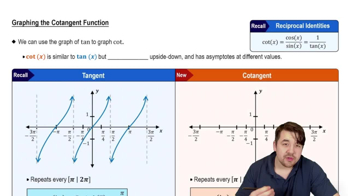
Tangent and cotangent are reciprocal functions, meaning tan(θ) = 1/cot(θ). This relationship helps convert between tan⁻¹ and cot⁻¹ expressions, allowing the equation to be rewritten in a single trigonometric function for easier solution.
Exact solutions involve finding precise angle values, often expressed in terms of inverse trig functions or special angles. Since inverse trig functions have principal value ranges, recognizing these ranges ensures the correct angle is identified as the solution.

 Verified step by step guidance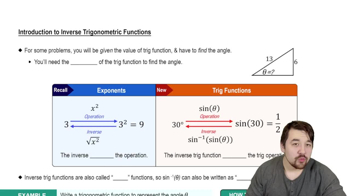
 4:28
4:28