Solve each equation for exact solutions. cos⁻¹ x = sin⁻¹ 3/5
Verified step by step guidance
1
Recognize that the problem involves inverse trigonometric functions: \( \cos^{-1}(x) \) and \( \sin^{-1}(\frac{3}{5}) \).
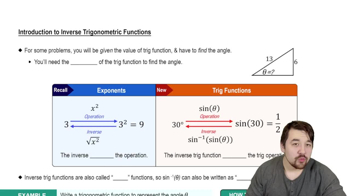
Understand that \( \sin^{-1}(\frac{3}{5}) \) represents an angle \( \theta \) such that \( \sin(\theta) = \frac{3}{5} \).
Use the Pythagorean identity \( \sin^2(\theta) + \cos^2(\theta) = 1 \) to find \( \cos(\theta) \). Substitute \( \sin(\theta) = \frac{3}{5} \) into the identity.
Calculate \( \cos(\theta) \) using the identity: \( \cos^2(\theta) = 1 - \sin^2(\theta) \).
Set \( \cos^{-1}(x) = \theta \) and solve for \( x \) using the value of \( \cos(\theta) \) obtained from the previous step.
Verified video answer for a similar problem:
This video solution was recommended by our tutors as helpful for the problem above
Play a video:
Was this helpful?
Key Concepts
Here are the essential concepts you must grasp in order to answer the question correctly.
Inverse Trigonometric Functions
Inverse trigonometric functions, such as cos⁻¹ (arccosine) and sin⁻¹ (arcsine), are used to find angles when given a ratio of sides in a right triangle. For example, if cos⁻¹ x = θ, then x is the cosine of angle θ. Understanding these functions is crucial for solving equations involving angles and their corresponding trigonometric ratios.
The Pythagorean identity states that for any angle θ, sin²(θ) + cos²(θ) = 1. This identity is essential when working with trigonometric equations, as it allows for the conversion between sine and cosine values. In the context of the given equation, it can be used to find the cosine value corresponding to sin⁻¹(3/5).
The range of inverse trigonometric functions is limited to specific intervals to ensure that each input corresponds to a unique output. For instance, the range of sin⁻¹ is [-π/2, π/2] and for cos⁻¹ is [0, π]. Recognizing these ranges is important when solving equations involving inverse functions, as it helps determine valid solutions within the specified intervals.