Ch. 1 - Trigonometric Functions
Lial - Trigonometry 12th Edition
Lial12th EditionTrigonometryISBN: 9780136552161Not the one you use?Change textbook
Chapter 2, Problem 75

Give all six trigonometric function values for each angle θ. Rationalize denominators when applicable. See Examples 5–7.
sin θ = √5/7 , and θ is in quadrant I.

Verified step by step guidance
1
Recall the six trigonometric functions: sine (sin), cosine (cos), tangent (tan), cosecant (csc), secant (sec), and cotangent (cot). We are given sin \( \theta = \frac{\sqrt{5}}{7} \) and that \( \theta \) is in quadrant I, where all trigonometric functions are positive.
Use the Pythagorean identity to find cos \( \theta \): \( \sin^2 \theta + \cos^2 \theta = 1 \). Substitute \( \sin \theta = \frac{\sqrt{5}}{7} \) to get \( \left( \frac{\sqrt{5}}{7} \right)^2 + \cos^2 \theta = 1 \).
Simplify the equation: \( \frac{5}{49} + \cos^2 \theta = 1 \). Then solve for \( \cos^2 \theta \) by subtracting \( \frac{5}{49} \) from both sides: \( \cos^2 \theta = 1 - \frac{5}{49} \).
Calculate \( \cos \theta \) by taking the positive square root (since \( \theta \) is in quadrant I): \( \cos \theta = \sqrt{1 - \frac{5}{49}} \).
Find the remaining trigonometric functions using the definitions: \( \tan \theta = \frac{\sin \theta}{\cos \theta} \), \( \csc \theta = \frac{1}{\sin \theta} \), \( \sec \theta = \frac{1}{\cos \theta} \), and \( \cot \theta = \frac{1}{\tan \theta} \). Rationalize denominators where necessary.

Verified video answer for a similar problem:

This video solution was recommended by our tutors as helpful for the problem above.
Video duration:
10m
Was this helpful?

Key Concepts

Here are the essential concepts you must grasp in order to answer the question correctly.

Definition of the Six Trigonometric Functions

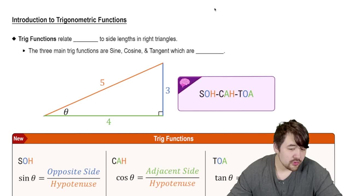
The six trigonometric functions—sine, cosine, tangent, cosecant, secant, and cotangent—are ratios derived from a right triangle or the unit circle. Given sin θ, the other functions can be found using their relationships, such as tan θ = sin θ / cos θ and reciprocal identities like csc θ = 1 / sin θ.
Recommended video:
6:04
Introduction to Trigonometric Functions

Using the Pythagorean Identity to Find Cosine

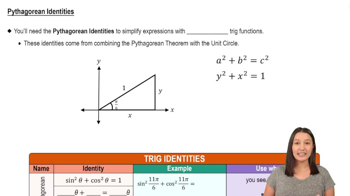
The Pythagorean identity states that sin²θ + cos²θ = 1. Knowing sin θ allows calculation of cos θ by rearranging to cos θ = ±√(1 - sin²θ). The sign depends on the quadrant of θ, which is quadrant I here, so cosine is positive.
Recommended video:
6:25
Pythagorean Identities

Quadrant Sign Rules for Trigonometric Functions

The sign of trigonometric functions depends on the quadrant of the angle. In quadrant I, all six functions are positive. This information is crucial for correctly determining the signs of cosine, tangent, and their reciprocals when calculating their values.
Recommended video:
6:04
Introduction to Trigonometric Functions