In Exercises 1–4, u and v have the same direction. In each exercise:Find ||v||.
Verified step by step guidance
1
insert step 1> Identify that vectors \( \mathbf{u} \) and \( \mathbf{v} \) have the same direction, meaning they are scalar multiples of each other.
insert step 2> Express \( \mathbf{v} \) as \( \mathbf{v} = k \mathbf{u} \), where \( k \) is a scalar.
insert step 3> Use the property of magnitudes: \( ||\mathbf{v}|| = |k| \cdot ||\mathbf{u}|| \).
insert step 4> Determine the scalar \( k \) by comparing the components of \( \mathbf{u} \) and \( \mathbf{v} \) if given, or use any additional information provided in the problem.
insert step 5> Calculate \( ||\mathbf{v}|| \) using the formula from step 3, substituting the known values of \( k \) and \( ||\mathbf{u}|| \).
Verified video answer for a similar problem:
This video solution was recommended by our tutors as helpful for the problem above
Video duration:
1m
Play a video:
Was this helpful?
Key Concepts
Here are the essential concepts you must grasp in order to answer the question correctly.
Magnitude of a Vector
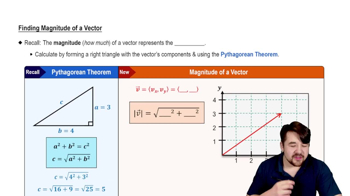
The magnitude of a vector, denoted as ||v||, represents its length or size in a given direction. It is calculated using the formula ||v|| = √(v₁² + v₂² + ... + vₙ²) for a vector v = (v₁, v₂, ..., vₙ) in n-dimensional space. Understanding how to compute the magnitude is essential for analyzing vectors in trigonometry.
Vectors have both magnitude and direction, and when two vectors u and v have the same direction, they are scalar multiples of each other. This means that one vector can be expressed as a scaled version of the other, which is crucial for solving problems involving vector relationships. Recognizing this property helps in simplifying calculations and understanding vector operations.
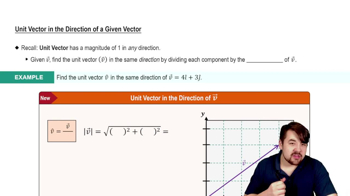
A unit vector is a vector with a magnitude of 1, used to indicate direction without regard to magnitude. To find a unit vector in the direction of a vector v, you divide v by its magnitude: u = v / ||v||. This concept is important in trigonometry as it allows for the normalization of vectors, making it easier to work with directional components in various applications.