In Exercises 1–4, u and v have the same direction. In each exercise:Find ||u||.
Verified step by step guidance
1
insert step 1
insert step 2
insert step 3
insert step 4
insert step 5
Verified video answer for a similar problem:
This video solution was recommended by our tutors as helpful for the problem above
Video duration:
2m
Play a video:
Was this helpful?
Key Concepts
Here are the essential concepts you must grasp in order to answer the question correctly.
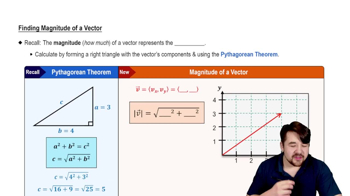
Magnitude of a Vector
The magnitude of a vector, denoted as ||u||, represents its length or size in a given space. It is calculated using the formula ||u|| = √(u₁² + u₂² + ... + uₙ²) for a vector u = (u₁, u₂, ..., uₙ) in n-dimensional space. Understanding how to compute the magnitude is essential for analyzing vector properties and their applications in physics and engineering.
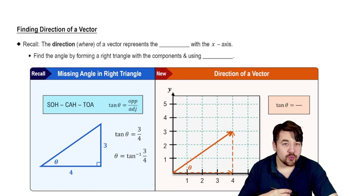
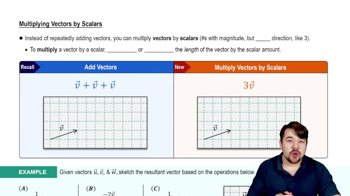
Vectors have both magnitude and direction, which means they can be represented graphically as arrows in a coordinate system. When two vectors u and v have the same direction, they are scalar multiples of each other, indicating that they point along the same line. This concept is crucial for understanding vector addition, scalar multiplication, and the geometric interpretation of vectors.
A unit vector is a vector with a magnitude of 1, used to indicate direction without regard to magnitude. Any vector can be converted into a unit vector by dividing it by its magnitude, resulting in a directionally equivalent vector. This concept is important for simplifying vector calculations and for applications in physics where direction is more significant than magnitude.