Use the definition of tangent in terms of sine and cosine: \( \tan \theta = \frac{\sin \theta}{\cos \theta} \). Substitute the expressions for \( \sin \theta \) and \( \cos \theta \) found in previous steps.
Simplify the resulting algebraic expression to write \( \tan \left( \sin^{-1} \left( \frac{u}{\sqrt{u^2 + 2}} \right) \right) \) purely in terms of \( u \).
Verified video answer for a similar problem:
This video solution was recommended by our tutors as helpful for the problem above
Play a video:
0 Comments
Key Concepts
Here are the essential concepts you must grasp in order to answer the question correctly.
Inverse Sine Function (sin⁻¹ or arcsin)
The inverse sine function, sin⁻¹(x), returns the angle whose sine is x. It is used to find an angle when the sine value is known, with a range typically between -π/2 and π/2. Understanding this helps convert trigonometric expressions involving arcsin into algebraic forms.
Right Triangle Definitions of Trigonometric Functions
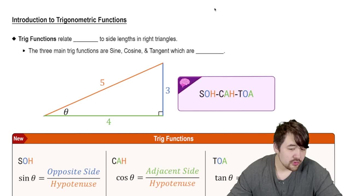
Trigonometric functions like sine and tangent can be interpreted as ratios of sides in a right triangle. For an angle θ, sin θ = opposite/hypotenuse and tan θ = opposite/adjacent. Using these ratios allows rewriting trigonometric expressions in terms of algebraic variables representing side lengths.
Algebraic Manipulation of Expressions Involving Radicals
Simplifying expressions with square roots and variables requires careful algebraic manipulation, such as rationalizing denominators or expressing radicals in simpler forms. This skill is essential to rewrite trigonometric expressions involving terms like √(u² + 2) into purely algebraic expressions in u.

 Verified step by step guidance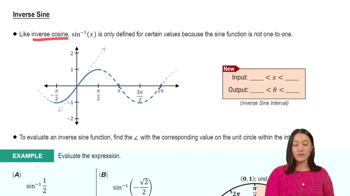
 4:03
4:03