Eliminate the parameter to rewrite the following as a rectangular equation.
Table of contents
- 0. Review of College Algebra4h 45m
- 1. Measuring Angles40m
- 2. Trigonometric Functions on Right Triangles2h 5m
- 3. Unit Circle1h 19m
- 4. Graphing Trigonometric Functions1h 19m
- 5. Inverse Trigonometric Functions and Basic Trigonometric Equations1h 41m
- 6. Trigonometric Identities and More Equations2h 34m
- 7. Non-Right Triangles1h 38m
- 8. Vectors2h 25m
- 9. Polar Equations2h 5m
- 10. Parametric Equations1h 6m
- 11. Graphing Complex Numbers1h 7m
10. Parametric Equations
Eliminate the Parameter
Problem 36
Textbook Question
In Exercises 21–40, eliminate the parameter t. Then use the rectangular equation to sketch the plane curve represented by the given parametric equations. Use arrows to show the orientation of the curve corresponding to increasing values of t. (If an interval for t is not specified, assume that −∞ < t < ∞.
x = 5 sec t, y = 3 tan t
Verified step by step guidance1
Start with the given parametric equations: \(x = 5 \sec t\) and \(y = 3 \tan t\).
Recall the fundamental trigonometric identity: \(\sec^2 t - \tan^2 t = 1\).
Express \(\sec t\) and \(\tan t\) in terms of \(x\) and \(y\) by isolating them from the parametric equations: \(\sec t = \frac{x}{5}\) and \(\tan t = \frac{y}{3}\).
Substitute these expressions into the identity to eliminate the parameter \(t\): \(\left(\frac{x}{5}\right)^2 - \left(\frac{y}{3}\right)^2 = 1\).
Simplify the equation to get the rectangular form of the curve: \(\frac{x^2}{25} - \frac{y^2}{9} = 1\). This represents a hyperbola. To sketch, plot this hyperbola and use the parametric definitions to determine the direction of increasing \(t\) by considering the signs of \(\sec t\) and \(\tan t\).
Verified video answer for a similar problem:This video solution was recommended by our tutors as helpful for the problem above
Video duration:
9mPlay a video:
0 Comments
Key Concepts
Here are the essential concepts you must grasp in order to answer the question correctly.
Parametric Equations and Parameter Elimination
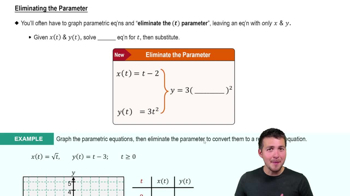
Parametric equations express coordinates (x, y) as functions of a parameter t. Eliminating the parameter involves rewriting these equations to form a single relationship between x and y, removing t. This process helps convert parametric forms into rectangular (Cartesian) equations for easier analysis and graphing.
Recommended video:
Eliminating the Parameter
Trigonometric Identities
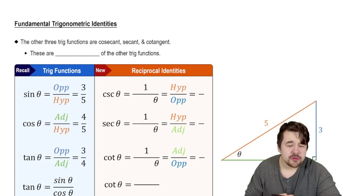
Trigonometric identities, such as sec²t - tan²t = 1, are essential tools for eliminating parameters involving trigonometric functions. These identities allow substitution and simplification, enabling the conversion of parametric equations into a rectangular form by relating sec t and tan t without the parameter t.
Recommended video:
Fundamental Trigonometric Identities
Curve Sketching and Orientation
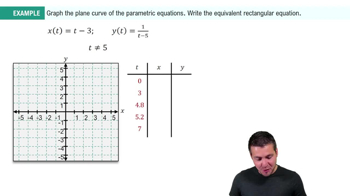
Sketching the curve involves plotting the rectangular equation and indicating the direction of increasing parameter t with arrows. Understanding orientation helps visualize how the curve is traced as t changes, which is important for interpreting motion or behavior of the curve in applications.
Recommended video:
Eliminate the Parameter Example 2
Related Videos
Related Practice
Multiple Choice
404
views