Solve each equation for x, where x is restricted to the given interval. y = √2 + 3 sec 2x, for x in [0, π/4) ⋃ (π/4, π/2]
Verified step by step guidance
1
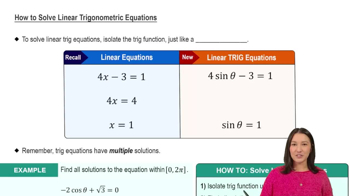
Start by isolating the trigonometric function: subtract \( \sqrt{2} \) from both sides to get \( 3 \sec(2x) = y - \sqrt{2} \).
Divide both sides by 3 to solve for \( \sec(2x) \): \( \sec(2x) = \frac{y - \sqrt{2}}{3} \).
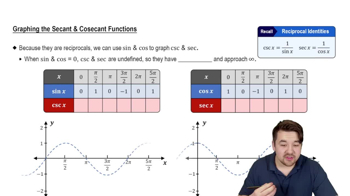
Recall that \( \sec(\theta) = \frac{1}{\cos(\theta)} \), so rewrite the equation as \( \cos(2x) = \frac{3}{y - \sqrt{2}} \).
Use the inverse cosine function to solve for \( 2x \): \( 2x = \cos^{-1}\left(\frac{3}{y - \sqrt{2}}\right) \).
Finally, solve for \( x \) by dividing by 2: \( x = \frac{1}{2} \cos^{-1}\left(\frac{3}{y - \sqrt{2}}\right) \), ensuring \( x \) is within the interval \([0, \frac{\pi}{4}) \cup (\frac{\pi}{4}, \frac{\pi}{2}]\).
Verified video answer for a similar problem:
This video solution was recommended by our tutors as helpful for the problem above
Play a video:
Was this helpful?
Key Concepts
Here are the essential concepts you must grasp in order to answer the question correctly.
Secant Function
The secant function, denoted as sec(x), is the reciprocal of the cosine function. It is defined as sec(x) = 1/cos(x). Understanding the secant function is crucial for solving equations involving it, as it can lead to transformations that simplify the equation. Additionally, the secant function has specific properties and behaviors, particularly in relation to its domain and range, which are important when determining solutions within a given interval.
Interval notation is a mathematical notation used to represent a range of values. In this context, the interval [0, π/4) ⋃ (π/4, π/2] indicates that x can take values from 0 to π/4, including 0 but not π/4, and from π/4 to π/2, including π/2 but not π/4. Understanding how to interpret and work with interval notation is essential for determining valid solutions to the equation within the specified ranges.
Solving trigonometric equations involves finding the values of the variable that satisfy the equation. This often requires using identities, algebraic manipulation, and understanding the properties of trigonometric functions. In this case, solving the equation y = √2 + 3 sec(2x) for x necessitates isolating the secant term and applying inverse functions, while also considering the restrictions imposed by the given intervals.