Find the exact value of each real number y if it exists. Do not use a calculator. y = arccos (―√3/2)
Verified step by step guidance
1
Understand that \( y = \arccos(-\sqrt{3}/2) \) means we are looking for an angle \( y \) whose cosine is \(-\sqrt{3}/2\).
Recall that the range of the \( \arccos \) function is \([0, \pi] \), which means \( y \) must be within this interval.
Identify the reference angle whose cosine is \( \sqrt{3}/2 \). This angle is \( \pi/6 \) or 30 degrees.
Since the cosine is negative, \( y \) must be in the second quadrant where cosine values are negative.
Determine the angle in the second quadrant by subtracting the reference angle from \( \pi \), i.e., \( y = \pi - \pi/6 \).
Verified video answer for a similar problem:
This video solution was recommended by our tutors as helpful for the problem above
Play a video:
0 Comments
Key Concepts
Here are the essential concepts you must grasp in order to answer the question correctly.
Inverse Trigonometric Functions
Inverse trigonometric functions, such as arccos, are used to find the angle whose cosine is a given value. For example, if y = arccos(x), then cos(y) = x. Understanding these functions is crucial for solving problems that involve finding angles from known trigonometric ratios.
The arccos function has a specific range of values, which is [0, π] for real numbers. This means that when you calculate arccos for a value, the result will always be an angle between 0 and π radians. Recognizing this range helps in determining the possible values of y when solving equations involving arccos.
Certain angles have known trigonometric values, which are often derived from the unit circle. For instance, cos(5π/6) = -√3/2. Familiarity with these special angles allows for quick identification of exact values when solving trigonometric equations, such as the one presented in the question.


 Verified step by step guidance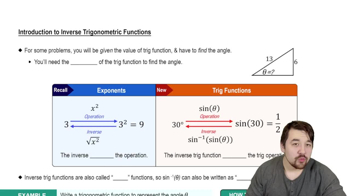
 4:28
4:28