Determine an equation of the form y = a cos bx or y = a sin bx, where b > 0, for the given graph. See Example 6. <IMAGE>
Verified step by step guidance
1
Identify the type of trigonometric function: Determine whether the graph resembles a sine or cosine function based on its shape and starting point.
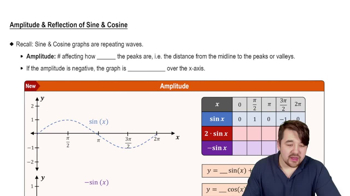
Determine the amplitude (a): Measure the vertical distance from the midline of the graph to a peak or trough. This value is the amplitude, |a|.
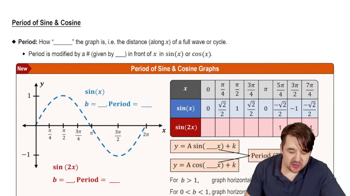
Determine the period: Measure the horizontal length of one complete cycle of the graph. Use the formula for the period of sine or cosine, which is \(\frac{2\pi}{b}\), to find b.
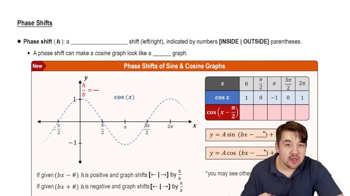
Determine the phase shift and vertical shift: If the graph is shifted horizontally or vertically, identify these shifts to adjust the standard form equation.
Write the equation: Substitute the values of a, b, and any shifts into the form \(y = a \cos(bx)\) or \(y = a \sin(bx)\) to get the equation of the graph.
Verified video answer for a similar problem:
This video solution was recommended by our tutors as helpful for the problem above
Play a video:
Was this helpful?
Key Concepts
Here are the essential concepts you must grasp in order to answer the question correctly.
Amplitude
Amplitude refers to the maximum height of a wave from its central axis. In the equations y = a cos(bx) or y = a sin(bx), the value 'a' represents the amplitude. It determines how far the graph stretches vertically from the midline, affecting the overall height of the peaks and depth of the troughs.
The period of a trigonometric function is the distance along the x-axis required for the function to complete one full cycle. In the equations y = a cos(bx) or y = a sin(bx), the period is calculated as 2π/b. Understanding the period is essential for accurately sketching the graph and determining how frequently the wave oscillates.
Phase shift refers to the horizontal displacement of the graph of a trigonometric function. It occurs when the function is adjusted by adding or subtracting a constant inside the argument of the sine or cosine function. This concept is crucial for aligning the graph with specific features, such as starting points or peaks, based on the given graph.