Recognize that \(-\frac{5\pi}{6}\) is an angle in radians. Convert it to degrees if necessary for better understanding: \(-\frac{5\pi}{6} \times \frac{180}{\pi} = -150^\circ\).
Understand that the sine function is periodic with a period of \(2\pi\) radians (or 360°). Therefore, \(\sin(-\theta) = -\sin(\theta)\).
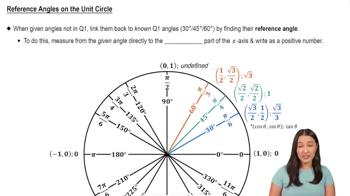
Since \(-150^\circ\) is in the third quadrant, find the reference angle. The reference angle for \(-150^\circ\) is \(180^\circ - 150^\circ = 30^\circ\).
Recall that the sine of a reference angle \(30^\circ\) is \(\frac{1}{2}\).
Apply the identity for sine in the third quadrant: \(\sin(-150^\circ) = -\sin(30^\circ)\).
Verified video answer for a similar problem:
This video solution was recommended by our tutors as helpful for the problem above
Play a video:
Was this helpful?
Key Concepts
Here are the essential concepts you must grasp in order to answer the question correctly.
Unit Circle
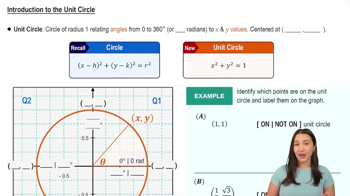
The unit circle is a circle with a radius of one centered at the origin of a coordinate plane. It is fundamental in trigonometry as it provides a geometric representation of the sine, cosine, and tangent functions. The angles measured in radians correspond to points on the circle, allowing for the determination of exact function values for various angles.
A reference angle is the acute angle formed by the terminal side of a given angle and the x-axis. For angles in the second and third quadrants, the reference angle helps in finding the sine, cosine, and tangent values by relating them to the corresponding angles in the first quadrant. Understanding reference angles is crucial for evaluating trigonometric functions for angles greater than π or less than -π.
The sine function, denoted as sin(θ), represents the ratio of the length of the opposite side to the hypotenuse in a right triangle. On the unit circle, it corresponds to the y-coordinate of a point at a given angle θ. Knowing the properties of the sine function, including its periodicity and symmetry, is essential for calculating exact values for angles like -5π/6.