Write each function as an expression involving functions of θ or x alone. See Example 2. cos(45° - θ)
Verified step by step guidance
1
Recognize that the expression cos(45° - θ) is a cosine of a difference of angles.
Use the cosine difference identity: \( \cos(a - b) = \cos a \cos b + \sin a \sin b \).
Substitute \( a = 45° \) and \( b = \theta \) into the identity: \( \cos(45° - \theta) = \cos 45° \cos \theta + \sin 45° \sin \theta \).
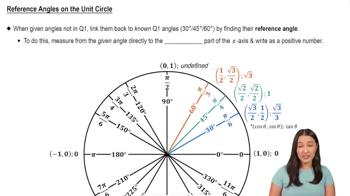
Recall the exact trigonometric values: \( \cos 45° = \frac{\sqrt{2}}{2} \) and \( \sin 45° = \frac{\sqrt{2}}{2} \).
Substitute these values into the expression: \( \cos(45° - \theta) = \frac{\sqrt{2}}{2} \cos \theta + \frac{\sqrt{2}}{2} \sin \theta \).
Verified video answer for a similar problem:
This video solution was recommended by our tutors as helpful for the problem above
Play a video:
0 Comments
Key Concepts
Here are the essential concepts you must grasp in order to answer the question correctly.
Trigonometric Identities
Trigonometric identities are equations that involve trigonometric functions and are true for all values of the variables involved. They are essential for simplifying expressions and solving trigonometric equations. For example, the cosine of a difference can be expressed using the identity cos(a - b) = cos(a)cos(b) + sin(a)sin(b), which is crucial for rewriting functions like cos(45° - θ).
Understanding angle measurement is fundamental in trigonometry, as angles can be expressed in degrees or radians. In this context, 45° is a specific angle that corresponds to π/4 radians. Recognizing how to convert between these two systems and knowing the values of trigonometric functions at key angles (like 0°, 30°, 45°, 60°, and 90°) is vital for solving problems involving angles.
Function composition in trigonometry involves combining functions to create new expressions. In the case of cos(45° - θ), we are looking at the composition of the cosine function with a linear transformation of the angle θ. This concept is important for manipulating and simplifying trigonometric expressions, allowing us to express complex functions in terms of simpler ones.

 Verified step by step guidance
 5:32
5:32