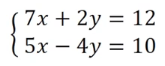
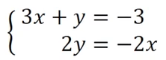
In solving systems of linear equations, the elimination method offers a systematic approach to simplify the process by eliminating one variable through addition. This method is particularly effective when equations are already in standard form, allowing for straightforward alignment of coefficients. The goal is to manipulate the equations so that when added together, one variable cancels out, making it easier to solve for the remaining variable.
To illustrate, consider the equations:
1. \(3x + 2y = 1\)
2. \(-x + y = 3\)
First, ensure both equations are in standard form, aligning the coefficients of \(x\), \(y\), and the constants vertically. If direct addition does not eliminate a variable, you may need to multiply one or both equations by a suitable number to create equal and opposite coefficients. For instance, multiplying the second equation by 3 yields:
1. \(3x + 2y = 1\)
2. \(-3x + 3y = 9\)
Now, adding these equations results in:
\((3x - 3x) + (2y + 3y) = 1 + 9\)
which simplifies to:
\(5y = 10\)
Thus, \(y = 2\).
With \(y\) determined, substitute this value back into either original equation to find \(x\). Using the second equation:
\(-x + 2 = 3\
Subtracting 2 from both sides gives:
\(-x = 1\
Therefore, \(x = -1\).
The solution to the system is the ordered pair \((-1, 2)\). To verify, substitute both values back into the original equations to ensure they satisfy both equations, confirming the solution's accuracy. The elimination method is a powerful tool for efficiently solving systems of equations, especially when dealing with larger coefficients or when equations are already aligned in standard form.