Bear Markets Explain why it does not make sense to find a least-squares regression line for the Bear Market data from Problem 34 in Section 4.1.
Table of contents
- 1. Intro to Stats and Collecting Data1h 14m
- 2. Describing Data with Tables and Graphs1h 55m
- 3. Describing Data Numerically2h 5m
- 4. Probability2h 16m
- 5. Binomial Distribution & Discrete Random Variables3h 6m
- 6. Normal Distribution and Continuous Random Variables2h 11m
- 7. Sampling Distributions & Confidence Intervals: Mean3h 23m
- Sampling Distribution of the Sample Mean and Central Limit Theorem19m
- Distribution of Sample Mean - Excel23m
- Introduction to Confidence Intervals15m
- Confidence Intervals for Population Mean1h 18m
- Determining the Minimum Sample Size Required12m
- Finding Probabilities and T Critical Values - Excel28m
- Confidence Intervals for Population Means - Excel25m
- 8. Sampling Distributions & Confidence Intervals: Proportion1h 25m
- 9. Hypothesis Testing for One Sample3h 29m
- 10. Hypothesis Testing for Two Samples4h 50m
- Two Proportions1h 13m
- Two Proportions Hypothesis Test - Excel28m
- Two Means - Unknown, Unequal Variance1h 3m
- Two Means - Unknown Variances Hypothesis Test - Excel12m
- Two Means - Unknown, Equal Variance15m
- Two Means - Unknown, Equal Variances Hypothesis Test - Excel9m
- Two Means - Known Variance12m
- Two Means - Sigma Known Hypothesis Test - Excel21m
- Two Means - Matched Pairs (Dependent Samples)42m
- Matched Pairs Hypothesis Test - Excel12m
- 11. Correlation1h 24m
- 12. Regression1h 50m
- 13. Chi-Square Tests & Goodness of Fit2h 21m
- 14. ANOVA1h 57m
12. Regression
Linear Regression & Least Squares Method
Problem 9.1.9
Textbook Question
"In Exercises 9 and 10, identify the explanatory variable and the response variable.
9. A nutritionist wants to determine whether the amounts of water consumed each day by persons of the same weight and on the same diet can be used to predict individual weight
loss."
Verified step by step guidance1
Step 1: Understand the problem by identifying the two variables involved. The problem mentions 'amounts of water consumed each day' and 'individual weight loss.' These are the two variables we need to classify as explanatory and response variables.
Step 2: Recall the definitions of explanatory and response variables. The explanatory variable is the one that is manipulated or used to explain changes in another variable, while the response variable is the outcome or the variable being measured.
Step 3: Analyze the relationship described in the problem. The nutritionist wants to determine if the 'amounts of water consumed each day' can be used to predict 'individual weight loss.' This suggests that the 'amounts of water consumed each day' is the variable being used to explain or predict changes in 'individual weight loss.'
Step 4: Assign the explanatory and response variables based on the analysis. The 'amounts of water consumed each day' is the explanatory variable because it is used to predict, and 'individual weight loss' is the response variable because it is the outcome being measured.
Step 5: Conclude that the explanatory variable is 'amounts of water consumed each day,' and the response variable is 'individual weight loss.' This classification helps in understanding the relationship being studied in the problem.
Verified video answer for a similar problem:This video solution was recommended by our tutors as helpful for the problem above
Video duration:
3mPlay a video:
Was this helpful?
Key Concepts
Here are the essential concepts you must grasp in order to answer the question correctly.
Explanatory Variable
The explanatory variable, also known as the independent variable, is the factor that is manipulated or categorized to observe its effect on another variable. In the context of the question, it refers to the amount of water consumed each day, as this is the variable the nutritionist is examining to see how it influences weight loss.
Recommended video:
Guided course
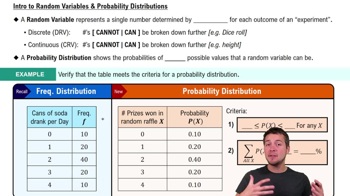
Intro to Random Variables & Probability Distributions
Response Variable
The response variable, or dependent variable, is the outcome that is measured to assess the effect of the explanatory variable. In this scenario, the response variable is individual weight loss, as it is the result that the nutritionist aims to predict based on the amount of water consumed.
Recommended video:
Guided course
Intro to Random Variables & Probability Distributions
Causation vs. Correlation
Understanding the difference between causation and correlation is crucial in statistics. Causation implies that changes in the explanatory variable directly cause changes in the response variable, while correlation indicates a relationship without implying direct influence. The nutritionist's study seeks to explore whether water consumption can causally affect weight loss, which requires careful analysis to establish.
Recommended video:
Guided course
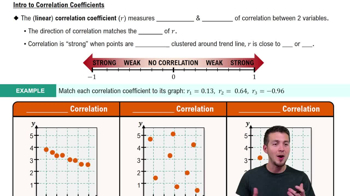
Correlation Coefficient
Watch next
Master Intro to Least Squares Regression with a bite sized video explanation from Patrick
Start learningRelated Videos
Related Practice
Textbook Question
2
views