Find the exact value of each real number y if it exists. Do not use a calculator. y = arcsec (2√3)/3
Verified step by step guidance
1
Understand that \( y = \text{arcsec}(x) \) means \( \sec(y) = x \).
Set up the equation \( \sec(y) = \frac{2\sqrt{3}}{3} \).
Recall that \( \sec(y) = \frac{1}{\cos(y)} \), so \( \cos(y) = \frac{3}{2\sqrt{3}} \).
Simplify \( \cos(y) = \frac{3}{2\sqrt{3}} \) to \( \cos(y) = \frac{\sqrt{3}}{2} \) by rationalizing the denominator.
Determine the angle \( y \) where \( \cos(y) = \frac{\sqrt{3}}{2} \) within the range \( [0, \pi] \) for arcsec.
Verified video answer for a similar problem:
This video solution was recommended by our tutors as helpful for the problem above
Play a video:
0 Comments
Key Concepts
Here are the essential concepts you must grasp in order to answer the question correctly.
Arcsecant Function
The arcsecant function, denoted as arcsec(x), is the inverse of the secant function. It is defined for values of x where |x| ≥ 1, and it returns an angle whose secant is x. Understanding this function is crucial for solving problems involving angles and their corresponding secant values.
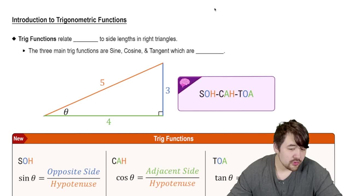
Trigonometric ratios relate the angles of a triangle to the lengths of its sides. In the context of the secant function, sec(θ) is defined as the ratio of the hypotenuse to the adjacent side in a right triangle. Knowing how to manipulate these ratios is essential for finding exact values of angles.
Exact values of trigonometric functions refer to specific angles where the sine, cosine, and tangent values can be expressed as simple fractions or radicals. For example, angles like 30°, 45°, and 60° have well-known exact values. Recognizing these angles helps in determining the exact value of y in the given equation without the use of a calculator.


 Verified step by step guidance
 5:57
5:57