Solve each equation for exact solutions. tan⁻¹ x = cot⁻¹ 7/5
Verified step by step guidance
1
Recognize that \( \tan^{-1}(x) \) and \( \cot^{-1}(\frac{7}{5}) \) are inverse trigonometric functions, meaning they represent angles whose tangent and cotangent are \( x \) and \( \frac{7}{5} \) respectively.
Recall the identity \( \cot(\theta) = \frac{1}{\tan(\theta)} \). Therefore, \( \cot^{-1}(\frac{7}{5}) \) is the angle \( \theta \) such that \( \cot(\theta) = \frac{7}{5} \).
Express \( \tan(\theta) \) in terms of \( \cot(\theta) \): \( \tan(\theta) = \frac{1}{\cot(\theta)} = \frac{5}{7} \).
Set \( \tan^{-1}(x) = \tan^{-1}(\frac{5}{7}) \) since both expressions represent the same angle.
Conclude that \( x = \frac{5}{7} \) by equating the arguments of the \( \tan^{-1} \) functions.
Verified video answer for a similar problem:
This video solution was recommended by our tutors as helpful for the problem above
Play a video:
Was this helpful?
Key Concepts
Here are the essential concepts you must grasp in order to answer the question correctly.
Inverse Trigonometric Functions
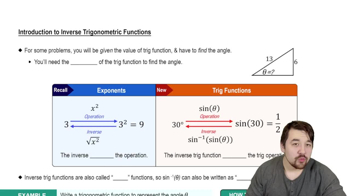
Inverse trigonometric functions, such as tan⁻¹ (arctangent) and cot⁻¹ (arccotangent), are used to find angles when given a ratio of sides in a right triangle. For example, tan⁻¹ x gives the angle whose tangent is x, while cot⁻¹ 7/5 gives the angle whose cotangent is 7/5. Understanding these functions is essential for solving equations involving angles and their relationships.
Trigonometric identities are equations that involve trigonometric functions and are true for all values of the variables involved. Key identities include the Pythagorean identity, reciprocal identities, and co-function identities. These identities can be used to simplify expressions and solve equations, making them crucial for finding exact solutions in trigonometric problems.
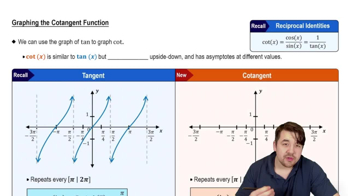
The tangent and cotangent functions are reciprocals of each other, meaning that tan(θ) = 1/cot(θ) and cot(θ) = 1/tan(θ). This relationship allows us to convert between the two functions when solving equations. In the given problem, recognizing that tan⁻¹ x = cot⁻¹ 7/5 implies that x can be expressed in terms of the cotangent function, facilitating the solution process.