Find the exact value of each real number y if it exists. Do not use a calculator. y = sec⁻¹ 1
Verified step by step guidance
1
Understand that \( y = \sec^{-1}(1) \) means we are looking for an angle \( y \) such that \( \sec(y) = 1 \).
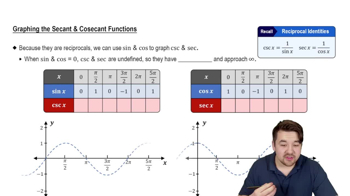
Recall that the secant function, \( \sec(y) \), is the reciprocal of the cosine function, \( \cos(y) \). Therefore, \( \sec(y) = 1 \) implies \( \cos(y) = 1 \).
Identify the angle \( y \) for which \( \cos(y) = 1 \). This occurs at \( y = 0 \) radians (or \( y = 0^\circ \)).
Verify that \( y = 0 \) is within the range of the inverse secant function, which is \([0, \pi] \) excluding \( \frac{\pi}{2} \).
Conclude that the exact value of \( y \) is \( 0 \) radians, as it satisfies all conditions.
Verified video answer for a similar problem:
This video solution was recommended by our tutors as helpful for the problem above
Play a video:
0 Comments
Key Concepts
Here are the essential concepts you must grasp in order to answer the question correctly.
Inverse Trigonometric Functions
Inverse trigonometric functions, such as sec⁻¹ (arcsec), are used to find the angle whose secant is a given number. For example, if y = sec⁻¹(1), we are looking for an angle θ such that sec(θ) = 1. Understanding these functions is crucial for solving problems involving angles and their corresponding trigonometric ratios.
The secant function, denoted as sec(θ), is defined as the reciprocal of the cosine function: sec(θ) = 1/cos(θ). It is important to know the values of secant at key angles, as this helps in determining the angles corresponding to specific secant values, such as sec(0) = 1, which is relevant for finding y in the given problem.
The range of the inverse secant function, sec⁻¹(x), is restricted to angles in the intervals [0, π/2) and (π/2, π]. This means that when solving for y = sec⁻¹(1), we must consider these intervals to find valid angle solutions. Understanding the domain and range of inverse functions is essential for correctly interpreting their outputs.


 Verified step by step guidance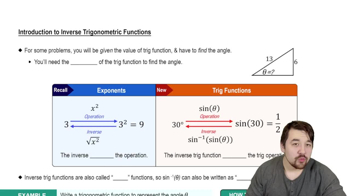
 4:28
4:28