The following equations cannot be solved by algebraic methods. Use a graphing calculator to find all solutions over the interval [0, 6]. Express solutions to four decimal places. (arctan x)³ ― x + 2 = 0
Verified step by step guidance
1
Rewrite the equation to isolate the expression involving the arctangent function: \( (\arctan x)^3 - x + 2 = 0 \).
Understand that this equation is transcendental because it involves both the inverse tangent function and a polynomial term, making algebraic solutions infeasible.
Use a graphing calculator or graphing software to plot the function \( f(x) = (\arctan x)^3 - x + 2 \) over the interval \([0, 6]\).
Identify the points where the graph intersects the x-axis; these x-values are the solutions to the equation within the given interval.
Use the calculator's root-finding feature to approximate each solution to four decimal places.
Verified video answer for a similar problem:
This video solution was recommended by our tutors as helpful for the problem above
Play a video:
0 Comments
Key Concepts
Here are the essential concepts you must grasp in order to answer the question correctly.
Inverse Trigonometric Functions
Inverse trigonometric functions, like arctan(x), return the angle whose tangent is x. Understanding their domains and ranges is essential, as arctan(x) outputs values between -π/2 and π/2, which affects the behavior of the equation and the possible solutions.
Graphical methods involve plotting the functions on both sides of the equation and identifying their intersection points. This approach is useful when algebraic manipulation is difficult or impossible, allowing approximate solutions to be found visually or with a graphing calculator.
Numerical methods and graphing calculators provide approximate solutions to equations that cannot be solved exactly. Expressing solutions to four decimal places requires understanding rounding rules and the limitations of numerical accuracy in computational tools.

 Verified step by step guidance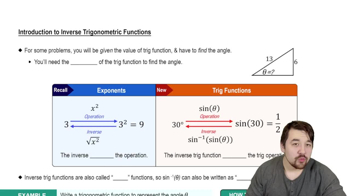
 4:28
4:28