Use a calculator to approximate each value in decimal degrees. θ = csc⁻¹ 1.9422833
Verified step by step guidance
1
Understand that \( \csc^{-1}(x) \) is the inverse cosecant function, which gives the angle \( \theta \) whose cosecant is \( x \).
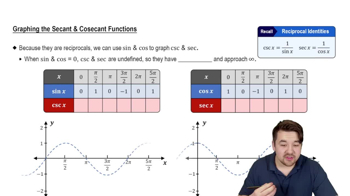
Recall that \( \csc(\theta) = \frac{1}{\sin(\theta)} \). Therefore, \( \csc^{-1}(1.9422833) \) means finding \( \theta \) such that \( \csc(\theta) = 1.9422833 \).
Convert the equation \( \csc(\theta) = 1.9422833 \) to \( \sin(\theta) = \frac{1}{1.9422833} \).
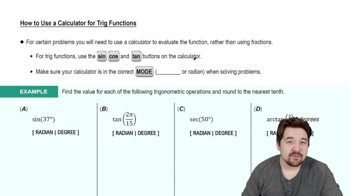
Use a calculator to find \( \sin(\theta) \) by computing \( \frac{1}{1.9422833} \).
Finally, use the inverse sine function on your calculator to find \( \theta \) in decimal degrees by calculating \( \sin^{-1}(\frac{1}{1.9422833}) \).
Verified video answer for a similar problem:
This video solution was recommended by our tutors as helpful for the problem above
Play a video:
Was this helpful?
Key Concepts
Here are the essential concepts you must grasp in order to answer the question correctly.
Cosecant Function
The cosecant function, denoted as csc(θ), is the reciprocal of the sine function. It is defined as csc(θ) = 1/sin(θ). Understanding this function is crucial for solving problems involving angles and their relationships in trigonometry, particularly when dealing with inverse functions.
Inverse trigonometric functions, such as csc⁻¹(x), are used to find the angle whose cosecant is x. These functions allow us to determine angles from given ratios, which is essential for solving trigonometric equations and understanding the relationships between angles and their corresponding trigonometric values.
Using a calculator to approximate trigonometric values involves understanding how to input functions correctly. For inverse functions like csc⁻¹, it is important to ensure the calculator is set to the correct mode (degrees or radians) to obtain accurate results. This skill is vital for effectively solving trigonometric problems in practical applications.