Textbook Question
Find the exact value of each real number y. Do not use a calculator.
y = sin⁻¹ √2/2
706
views

 Lial 12th EditionCh. 6 - Inverse Circular Functions and Trigonometric EquationsProblem 5
 Verified step by step guidance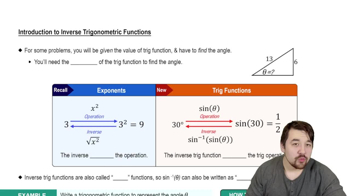
 4:28
4:28
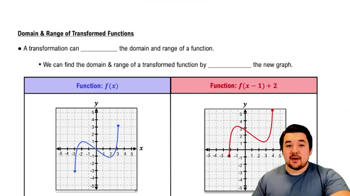 4:22
4:22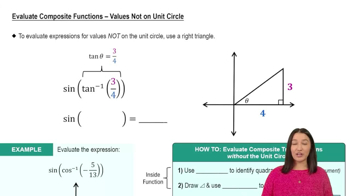 7:28
7:28Find the exact value of each real number y. Do not use a calculator.
y = sin⁻¹ √2/2
The point (π/4, 1) lies on the graph of y = tan x. Therefore, the point _______ lies on the graph of y = tan⁻¹ x.
Solve each equation for x.
y = 1/2 tan (3x + 2), for x in [-2/3 - π/6, -2/3 + π/6]
Decide whether each statement is true or false. If false, explain why.
The tangent and secant functions are undefined for the same values.
The following equations cannot be solved by algebraic methods. Use a graphing calculator to find all solutions over the interval [0, 2π). Express solutions to four decimal places.
x² + sin x - x³ - cos x = 0
Solve each equation over the interval [0°, 360°). Write solutions as exact values or to the nearest tenth, as appropriate.
2 tan θ sin θ - tan θ = 0