Write each function as an expression involving functions of θ or x alone. See Example 2. cos(45° - θ)
Verified step by step guidance
1
Recall the cosine difference identity: \(\cos(A - B) = \cos A \cos B + \sin A \sin B\).
Identify the angles in the expression: here, \(A = 45^\circ\) and \(B = \theta\).
Apply the identity to rewrite \(\cos(45^\circ - \theta)\) as \(\cos 45^\circ \cos \theta + \sin 45^\circ \sin \theta\).
Substitute the known exact values for \(\cos 45^\circ\) and \(\sin 45^\circ\), which are both \(\frac{\sqrt{2}}{2}\).
Write the final expression as \(\frac{\sqrt{2}}{2} \cos \theta + \frac{\sqrt{2}}{2} \sin \theta\), involving only functions of \(\theta\).
Verified video answer for a similar problem:
This video solution was recommended by our tutors as helpful for the problem above
Play a video:
0 Comments
Key Concepts
Here are the essential concepts you must grasp in order to answer the question correctly.
Angle Difference Identity for Cosine
The angle difference identity states that cos(A - B) = cos A cos B + sin A sin B. This formula allows expressing the cosine of a difference of two angles as a combination of sines and cosines of the individual angles, facilitating simplification or evaluation.
Special angles like 45° have known exact sine and cosine values (e.g., cos 45° = sin 45° = √2/2). Using these values simplifies expressions involving these angles, making it easier to rewrite functions in terms of θ or x alone.
Rewriting trigonometric expressions to involve only one variable (θ or x) requires understanding function notation and how to isolate terms. This helps in expressing complex functions as simpler combinations of functions of a single variable.

 Verified step by step guidance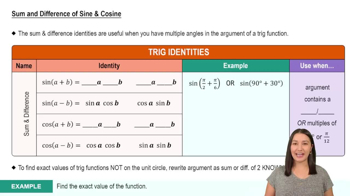
 06:14
06:14