
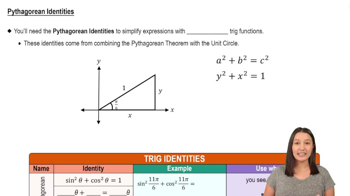
Substitute \( \sin^2 \theta \) for \( 1 - \cos^2 \theta \) in the factored expression: \( \sin \theta \cdot \sin^2 \theta \).
Simplify the expression to \( \sin^3 \theta \), confirming that both sides of the equation are equal, thus verifying the identity.
Verified video answer for a similar problem:
This video solution was recommended by our tutors as helpful for the problem above
Play a video:
Was this helpful?
Key Concepts
Here are the essential concepts you must grasp in order to answer the question correctly.
Trigonometric Identities
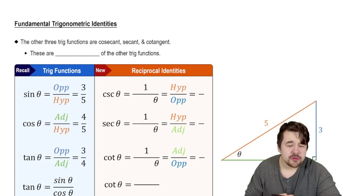
Trigonometric identities are equations that hold true for all values of the variable where both sides are defined. Common identities include the Pythagorean identities, reciprocal identities, and co-function identities. Understanding these identities is crucial for verifying equations, as they provide the foundational relationships between sine, cosine, and other trigonometric functions.
The sine and cosine functions are fundamental trigonometric functions that relate the angles of a right triangle to the ratios of its sides. The sine of an angle is the ratio of the opposite side to the hypotenuse, while the cosine is the ratio of the adjacent side to the hypotenuse. These functions are periodic and play a key role in various trigonometric identities and equations.
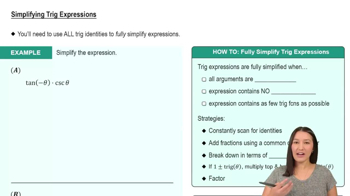
Algebraic manipulation involves rearranging and simplifying expressions using algebraic rules. This skill is essential for verifying identities, as it allows one to transform one side of an equation to match the other. Techniques include factoring, expanding, and applying known identities, which can help in proving that two expressions are equivalent.