


(Modeling) Length of a Sag Curve When a highway goes downhill and then uphill, it has a sag curve. Sag curves are designed so that at night, headlights shine sufficiently far down the road to allow a safe stopping distance. See the figure. S and L are in feet. The minimum length L of a sag curve is determined by the height h of the car's headlights above the pavement, the downhill grade θ₁ < 0°, the uphill grade θ₂ > 0°, and the safe stopping distance S for a given speed limit. In addition, L is dependent on the vertical alignment of the headlights. Headlights are usually pointed upward at a slight angle α above the horizontal of the car. Using these quantities, for a 55 mph speed limit, L can be modeled by the formula (θ₂ - θ₁)S² L = ————————— , 200(h + S tan α) where S < L. (Data from Mannering, F., and W. Kilareski, Principles of Highway Engineering and Traffic Analysis, Second Edition, John Wiley and Sons.) Compute length L, to the nearest foot, if h = 1.9 ft, α = 0.9°, θ₁ = -3°, θ₂ = 4°, and S = 336 ft.
3. Unit Circle
Trigonometric Functions on the Unit Circle
Multiple Choice
Find the sine, cosine, and tangent of each angle using the unit circle.
rad, 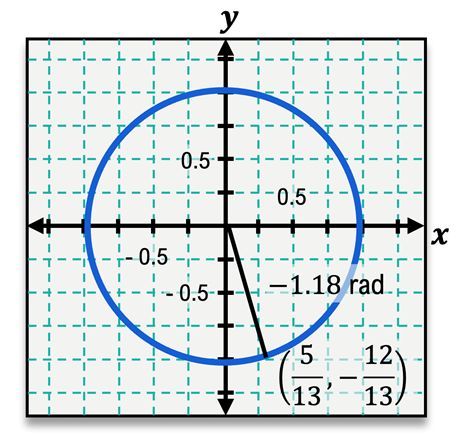
A
B
C
D
 Verified step by step guidance
1
Identify the coordinates of the point on the unit circle corresponding to the angle θ = -1.18 rad. From the image, the coordinates are (\(\frac{5}{13}\), -\(\frac{12}{13}\)).
Recall that on the unit circle, the x-coordinate of a point is the cosine of the angle, and the y-coordinate is the sine of the angle. Therefore, \(\cos\)(\(\theta\)) = \(\frac{5}{13}\) and \(\sin\)(\(\theta\)) = -\(\frac{12}{13}\).
To find the tangent of the angle, use the identity \(\tan\)(\(\theta\)) = \(\frac{\sin(\theta)}{\cos(\theta)}\). Substitute the values: \(\tan\)(\(\theta\)) = \(\frac{-\frac{12}{13}\)}{\(\frac{5}{13}\)}.
Simplify the expression for tangent: \(\tan\)(\(\theta\)) = \(\frac{-12}{13}\) \(\times\) \(\frac{13}{5}\) = -\(\frac{12}{5}\).
Verify the results: \(\sin\)(\(\theta\)) = -\(\frac{12}{13}\), \(\cos\)(\(\theta\)) = \(\frac{5}{13}\), \(\tan\)(\(\theta\)) = -\(\frac{12}{5}\). These match the correct answer provided in the problem statement.
Related Videos
Related Practice
Textbook Question
582
views


