Solve each equation over the interval [0°, 360°). Write solutions as exact values or to the nearest tenth, as appropriate. tan² θ + 4 tan θ + 2 = 0
Verified step by step guidance
1
Start by recognizing that the given equation is a quadratic in terms of \(\tan \theta\): \(\tan^{2} \theta + 4 \tan \theta + 2 = 0\).
Use the quadratic formula to solve for \(\tan \theta\). Recall the quadratic formula: \(x = \frac{-b \pm \sqrt{b^{2} - 4ac}}{2a}\), where \(a=1\), \(b=4\), and \(c=2\) in this case.
Calculate the discriminant \(\Delta = b^{2} - 4ac = 4^{2} - 4 \times 1 \times 2\) and then find the two possible values for \(\tan \theta\) using the quadratic formula.
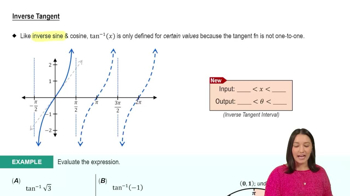
Once you have the two values for \(\tan \theta\), find the corresponding angles \(\theta\) by taking the arctangent (inverse tangent) of each value. Remember to consider the interval \([0^\circ, 360^\circ)\) and the periodicity and sign of the tangent function to find all solutions within this interval.
Write the solutions for \(\theta\) either as exact values (if they correspond to special angles) or rounded to the nearest tenth of a degree, as appropriate.
Verified video answer for a similar problem:
This video solution was recommended by our tutors as helpful for the problem above
Play a video:
0 Comments
Key Concepts
Here are the essential concepts you must grasp in order to answer the question correctly.
Solving Quadratic Equations
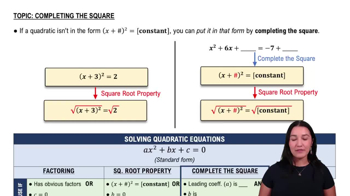
The given equation is quadratic in terms of tan θ, so solving it involves using methods like factoring, completing the square, or the quadratic formula to find values of tan θ that satisfy the equation.
Solving Quadratic Equations by Completing the Square
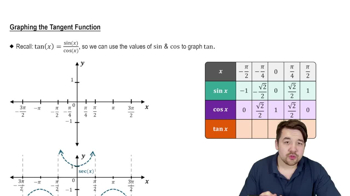
Properties of the Tangent Function
Understanding the tangent function's behavior, including its period of 180°, domain restrictions, and how to interpret solutions for θ within the interval [0°, 360°), is essential for finding all valid angle solutions.
After finding values for tan θ, use the inverse tangent function to determine θ. Since tangent is periodic, consider all angles in [0°, 360°) that correspond to the solutions, adjusting for the function's periodicity.