Evaluate each expression without using a calculator. tan⁻¹ (tan (π/4))
Verified step by step guidance
1
Recall that the function \( \tan^{-1}(x) \), also known as \( \arctan(x) \), is the inverse of the tangent function \( \tan(x) \) but its output (range) is restricted to \( \left(-\frac{\pi}{2}, \frac{\pi}{2}\right) \).
Identify the input inside the inverse tangent: \( \tan\left(\frac{\pi}{4}\right) \). Since \( \tan\left(\frac{\pi}{4}\right) = 1 \), the expression becomes \( \tan^{-1}(1) \).
Now, evaluate \( \tan^{-1}(1) \) by finding the angle \( \theta \) in the interval \( \left(-\frac{\pi}{2}, \frac{\pi}{2}\right) \) such that \( \tan(\theta) = 1 \).
Recall that \( \tan\left(\frac{\pi}{4}\right) = 1 \), and since \( \frac{\pi}{4} \) lies within the principal range of \( \arctan \), the value of \( \tan^{-1}(1) \) is \( \frac{\pi}{4} \).
Therefore, the expression \( \tan^{-1}(\tan(\frac{\pi}{4})) \) simplifies to \( \frac{\pi}{4} \).
Verified video answer for a similar problem:
This video solution was recommended by our tutors as helpful for the problem above
Play a video:
0 Comments
Key Concepts
Here are the essential concepts you must grasp in order to answer the question correctly.
Inverse Trigonometric Functions
Inverse trigonometric functions, like tan⁻¹ (arctan), reverse the effect of their corresponding trigonometric functions. For example, tan⁻¹(x) returns the angle whose tangent is x, typically within a principal value range to ensure a unique output.
The principal value of arctan is the interval (-π/2, π/2), meaning arctan returns angles only within this range. This restriction ensures the inverse function is well-defined and single-valued, which is crucial when evaluating expressions like tan⁻¹(tan(θ)).
The tangent function is periodic with period π, so tan(θ) = tan(θ + nπ) for any integer n. When evaluating tan⁻¹(tan(θ)), the result is the angle equivalent to θ within the principal range of arctan, requiring adjustment if θ lies outside (-π/2, π/2).

 Verified step by step guidance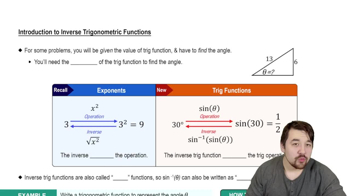
 4:28
4:28