Solve each equation for exact solutions. 2 arccos (x/3 - π/3) = 2π
Verified step by step guidance
1
Start by dividing both sides of the equation by 2 to isolate the arccos function: \( \arccos\left(\frac{x}{3} - \frac{\pi}{3}\right) = \pi \).
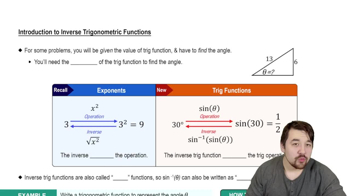
Recognize that the arccos function returns an angle whose cosine is the given value. Therefore, set up the equation: \( \cos(\pi) = \frac{x}{3} - \frac{\pi}{3} \).
Recall that \( \cos(\pi) = -1 \). Substitute this into the equation: \( -1 = \frac{x}{3} - \frac{\pi}{3} \).
Solve for \( x \) by first adding \( \frac{\pi}{3} \) to both sides: \( -1 + \frac{\pi}{3} = \frac{x}{3} \).
Multiply both sides by 3 to solve for \( x \): \( x = 3\left(-1 + \frac{\pi}{3}\right) \).
Verified video answer for a similar problem:
This video solution was recommended by our tutors as helpful for the problem above
Play a video:
Was this helpful?
Key Concepts
Here are the essential concepts you must grasp in order to answer the question correctly.
Arccosine Function
The arccosine function, denoted as arccos or cos⁻¹, is the inverse of the cosine function. It takes a value from the range [-1, 1] and returns an angle in the range [0, π]. Understanding how to manipulate and solve equations involving arccos is crucial for finding exact solutions in trigonometric problems.
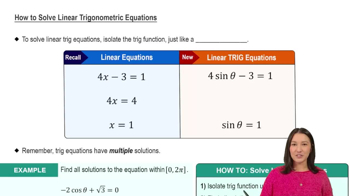
Solving trigonometric equations involves finding the angles that satisfy a given equation. This often requires using inverse trigonometric functions, identities, and algebraic manipulation. In this case, isolating the arccosine term and understanding its properties will help in determining the exact solutions.
Exact solutions in trigonometry refer to solutions expressed in terms of known constants or angles rather than decimal approximations. These solutions often involve special angles (like π/6, π/4, π/3) and can be derived from the properties of trigonometric functions and their inverses. Identifying these angles is essential for providing precise answers.