Textbook Question
Find the exact value of each real number y. Do not use a calculator.
y = sin⁻¹ √2/2
706
views

 Lial 12th EditionCh. 6 - Inverse Circular Functions and Trigonometric EquationsProblem 4
 Verified step by step guidance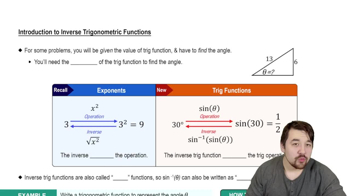
 4:28
4:28 4:28
4:28 5:43
5:43Find the exact value of each real number y. Do not use a calculator.
y = sin⁻¹ √2/2
Which one of the following equations has solution π?
a. arccos (―1) = x
b. arccos 1 = x
c. arcsin (―1) = x
Use the unit circle shown here to solve each simple trigonometric equation. If the variable is x, then solve over [0, 2π). If the variable is θ, then solve over [0°, 360°).
<IMAGE>
sin x = ―√3/2
Which one of the following equations has solution 3π/4
a. arctan 1 = x
b. arcsin √2/2 = x
c. arccos (―√2 /2) = x
Decide whether each statement is true or false. If false, explain why.
The tangent and secant functions are undefined for the same values.
Use the unit circle shown here to solve each simple trigonometric equation. If the variable is x, then solve over [0, 2π). If the variable is θ, then solve over [0°, 360°).
<IMAGE>
sin x = ―1/2