Find the degree measure of θ if it exists. Do not use a calculator. θ = arcsin (-√3/2)
Verified step by step guidance
1
Understand that \( \theta = \arcsin(-\sqrt{3}/2) \) means we are looking for an angle whose sine is \(-\sqrt{3}/2\).
Recall that the sine function is negative in the third and fourth quadrants.
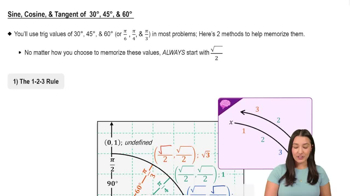
Identify the reference angle where \( \sin(\theta) = \sqrt{3}/2 \), which is \( 60^\circ \) or \( \pi/3 \) radians.
Determine the angles in the third and fourth quadrants that have a reference angle of \( 60^\circ \).
The angles are \( 180^\circ + 60^\circ = 240^\circ \) and \( 360^\circ - 60^\circ = 300^\circ \).
Verified video answer for a similar problem:
This video solution was recommended by our tutors as helpful for the problem above
Play a video:
Was this helpful?
Key Concepts
Here are the essential concepts you must grasp in order to answer the question correctly.
Inverse Trigonometric Functions
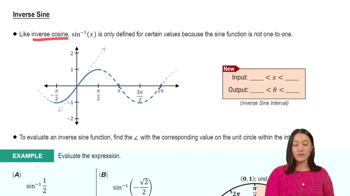
Inverse trigonometric functions, such as arcsin, are used to find the angle whose sine is a given value. For example, if θ = arcsin(x), then sin(θ) = x. Understanding the range and domain of these functions is crucial, as they can yield specific angle measures based on the input value.
The sine function outputs specific values for common angles, which are essential for solving trigonometric equations. For instance, sin(30°) = 1/2 and sin(120°) = √3/2. Recognizing these values helps in determining the angles corresponding to given sine values, especially when dealing with negative inputs.
The unit circle is divided into four quadrants, each corresponding to different signs of sine, cosine, and tangent. In the context of arcsin, the output is restricted to the first and fourth quadrants, where sine is positive and negative, respectively. This understanding is vital for determining the correct angle when the sine value is negative, as it indicates the angle's position in the fourth quadrant.