Write each trigonometric expression as an algebraic expression in u, for u > 0. tan (arcsec (√1―u²) / u)
Verified step by step guidance
1
Recognize that the expression is \( \tan(\arcsec(\frac{\sqrt{1 - u^2}}{u})) \). Here, \( \arcsec(x) \) is the inverse secant function, which returns an angle \( \theta \) such that \( \sec(\theta) = x \).
Set \( \theta = \arcsec\left(\frac{\sqrt{1 - u^2}}{u}\right) \). By definition, this means \( \sec(\theta) = \frac{\sqrt{1 - u^2}}{u} \).
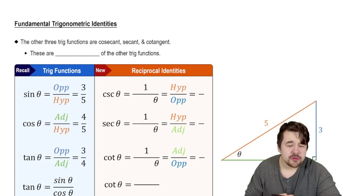
Recall the identity \( \sec(\theta) = \frac{1}{\cos(\theta)} \), so \( \cos(\theta) = \frac{u}{\sqrt{1 - u^2}} \).
Use the Pythagorean identity \( \sin^2(\theta) + \cos^2(\theta) = 1 \) to find \( \sin(\theta) \). Substitute \( \cos(\theta) \) and solve for \( \sin(\theta) \).
Finally, express \( \tan(\theta) = \frac{\sin(\theta)}{\cos(\theta)} \) in terms of \( u \) using the expressions found for \( \sin(\theta) \) and \( \cos(\theta) \).
Verified video answer for a similar problem:
This video solution was recommended by our tutors as helpful for the problem above
Play a video:
0 Comments
Key Concepts
Here are the essential concepts you must grasp in order to answer the question correctly.
Inverse Trigonometric Functions
Inverse trigonometric functions, like arcsec, return the angle whose trigonometric ratio matches the given value. Understanding how to interpret arcsec(x) as an angle θ such that sec(θ) = x is essential for rewriting expressions involving inverse functions.
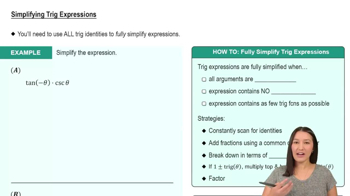
Key identities, such as sec²θ = 1 + tan²θ and the Pythagorean identity sin²θ + cos²θ = 1, help convert between trigonometric functions. These relationships allow expressing one function in terms of another, facilitating the simplification of composite expressions.
Converting trigonometric expressions into algebraic forms requires careful substitution and simplification. This involves expressing trigonometric ratios in terms of the variable u, applying square roots, and rationalizing expressions while considering domain restrictions like u > 0.

 Verified step by step guidance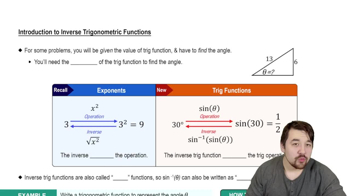
 4:28
4:28